

5 Key Properties of Polyimide PCB Materials: What Engineers Need to Know
When a printed circuit board must survive high temperatures, repeated bending, or demanding operating conditions, standard FR-4 is not always the right material. Polyimide PCB materials are designed for applications where thermal performance and flexibility justify a higher material and processing cost. The important question is not whether polyimide is technically impressive; it is whether its properties solve a real design problem.
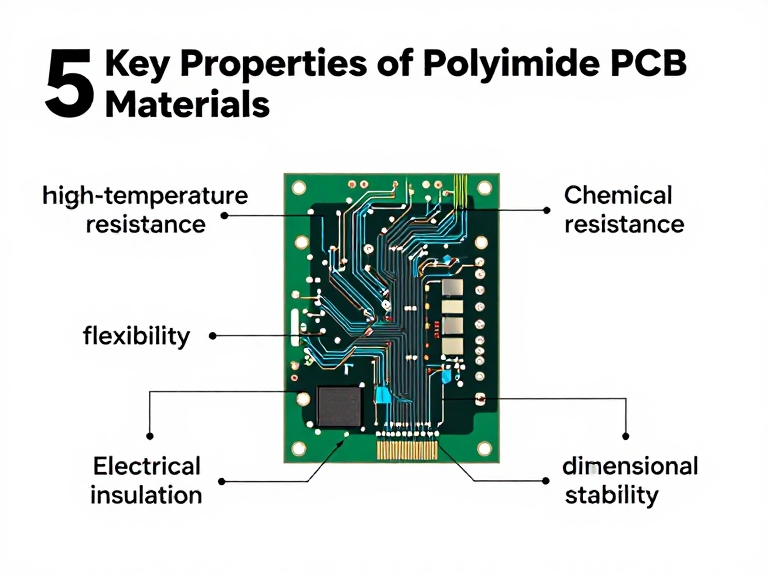
Table of Contents
- What Is Polyimide PCB Material?
- The 5 Main Properties of Polyimide PCB Materials
- How Polyimide Works in PCB Construction
- Polyimide vs. FR-4: Material Comparison
- Benefits, Limitations, and Pros vs. Cons
- Best Applications: Who Should Use Polyimide?
- Design and Buying Considerations
- Manufacturing Considerations and Wintech Capabilities
- Common Material Selection Mistakes
- Expert Recommendation
- Quick Summary Table
- Frequently Asked Questions
- References
What Is Polyimide PCB Material?
Polyimide is a high-performance polymer used as an insulating substrate or dielectric film in printed circuit boards. In flexible PCB construction, a thin polyimide film commonly supports copper traces while allowing the circuit to bend, fold, or fit into a compact enclosure. It is also used in rigid-flex designs, where flexible circuit sections connect rigid PCB areas.
Unlike a conventional rigid FR-4 laminate, polyimide is available in thin, flexible film constructions. That difference is valuable when a circuit must pass through a hinge, wrap around a component, fit into a narrow housing, or tolerate movement during normal operation. Polyimide is also selected for its ability to maintain useful electrical and mechanical characteristics in elevated-temperature environments.
However, polyimide is not one universal PCB material with one fixed set of specifications. Formulation, film thickness, copper type, adhesive system, surface treatment, and laminate construction all affect the finished circuit's performance. Engineers should evaluate the complete laminate system rather than relying on a generic claim such as "high-temperature polyimide."
The 5 Main Properties of Polyimide PCB Materials
1. High Thermal Stability
Thermal stability is one of the strongest reasons to specify polyimide. Polyimide films are known for retaining useful mechanical and electrical properties at temperatures that can exceed the practical operating range of many ordinary polymer substrates. This makes them suitable for electronics exposed to elevated ambient temperatures, localized heat, or demanding assembly processes.
For PCB designers, thermal stability matters at two different stages. First, the substrate must tolerate manufacturing operations such as soldering and component assembly. Second, the finished board must perform reliably at its actual operating temperature. A material that survives a short assembly temperature excursion is not automatically suitable for continuous high-temperature service.
From our experience, engineers should define the expected temperature profile before selecting a polyimide grade. Include normal operating temperature, peak temperature, exposure duration, thermal cycling, and any nearby heat sources. Check the manufacturer's data for glass transition temperature where relevant, continuous-use temperature, decomposition behavior, and the limits of the full laminate construction. These values describe different material characteristics and should not be treated as interchangeable.
2. Flexibility and Mechanical Fatigue Resistance
Polyimide's flexibility enables flexible printed circuits that can bend around components, connect moving assemblies, and reduce the need for bulky wire harnesses. In compact consumer electronics, cameras, medical instruments, automotive modules, and industrial controls, this can simplify packaging and improve connection reliability when the circuit is designed correctly.
There is an important distinction between a circuit that bends once during installation and one that flexes repeatedly during use. Static flex applications may tolerate a relatively tight bend when the design and material stack-up permit it. Dynamic flex applications—such as a circuit routed through a moving hinge—need more conservative geometry and fatigue-focused construction.
In most professional situations, the copper type and circuit geometry are just as important as the polyimide film. Rolled-annealed copper is often considered for demanding dynamic-flex applications because of its ductility. Copper thickness, trace direction, bend radius, neutral-axis position, coverlay design, and the number of layers all influence flex life.
We recommend that designers specify the expected number of bend cycles, minimum bend radius, bend angle, and whether the flex section moves continuously or only during assembly. A flexible substrate does not make every finished circuit suitable for repeated bending.
3. Strong Dielectric and Electrical Insulation Performance
Polyimide is an electrical insulator, which makes it suitable for separating conductive layers and supporting fine copper circuitry. Its dielectric properties help engineers manage electrical isolation, signal behavior, and insulation requirements in compact electronic assemblies.
For high-speed or high-frequency designs, the relevant question is not simply whether polyimide has good dielectric strength. The design team must also consider dielectric constant (Dk), dissipation factor (Df), frequency, resin or adhesive content, laminate thickness, copper roughness, and the geometry of the transmission line. These factors affect impedance and signal loss.
Polyimide should therefore not be assumed to outperform every other PCB laminate in every RF or high-speed application. Some specialized low-loss materials may be more appropriate when signal integrity is the dominant requirement. Polyimide is attractive when electrical insulation must be combined with flexibility, thermal performance, or a compact multilayer construction.
For beginners, the practical rule is straightforward: ask the PCB manufacturer for electrical data for the exact material system and frequency range. Do not copy a dielectric constant from an unrelated polyimide film datasheet and apply it to a finished adhesive-based flex laminate.
4. Chemical Resistance
Polyimide materials generally offer useful resistance to a range of chemicals, solvents, oils, and industrial environmental exposures. This can be valuable in equipment where a circuit may encounter cleaning agents, process chemicals, lubricants, or other substances during normal service.
But "chemical resistant" does not mean chemically indestructible. Resistance depends on the specific chemical, concentration, temperature, exposure time, mechanical stress, and the construction of the finished PCB. Adhesives, coverlays, surface finishes, component coatings, and connector materials may fail before the polyimide film itself.
For commercial users and industrial equipment designers, we recommend creating a chemical exposure list rather than asking for a broad resistance guarantee. Identify every expected fluid, cleaning process, concentration, temperature, and contact duration. Then request compatibility information for the complete flexible PCB assembly, not just the base film.
5. Dimensional Stability
Dimensional stability describes how well a material maintains its size and geometry through changes in temperature, humidity, and manufacturing processes. This property matters when a PCB includes fine-pitch components, closely aligned connectors, multilayer registration, or precise mechanical interfaces.
Polyimide is valued in demanding flexible and rigid-flex designs because suitable grades can provide good dimensional control. Nevertheless, flexible laminates can move during processing. Copper balance, material orientation, moisture conditioning, lamination conditions, panel design, and stress relief all affect registration and final dimensions.
For high-density interconnect (HDI) and multilayer flex designs, dimensional stability is a manufacturing issue as much as a datasheet issue. The fabricator must control material handling, drilling or laser processing, lamination, imaging, and inspection. A technically suitable film cannot compensate for an uncontrolled process.
How Polyimide Works in PCB Construction
In a flexible PCB, polyimide typically acts as the insulating film beneath or between copper conductor layers. Copper is patterned into traces and pads, while coverlay or another protective layer helps insulate and protect the finished circuitry. Depending on the design, the stack-up may use adhesive-based or adhesiveless copper-clad laminate.
Adhesive-based constructions bond copper foil to the polyimide film using an adhesive layer. They can be practical for many standard flex applications, but the adhesive affects thickness, thermal behavior, flexibility, and electrical performance. Adhesiveless laminates bond copper to the film without a conventional adhesive layer and may be selected when a thinner stack-up, improved thermal performance, or specific reliability characteristics are required.
Rigid-flex PCBs combine rigid sections with flexible polyimide sections in one interconnected construction. This can reduce connectors and cable assemblies, save space, and improve integration. The trade-off is a more complex stack-up and manufacturing process. For a broader understanding of board architecture, see our guide to PCB components and their functions.
The material selection must match the mechanical and electrical purpose of each section. A rigid-flex design should not treat its flexible region as an ordinary rigid PCB area with a thinner substrate. Bend zones, copper routing, coverlay openings, stiffeners, and transitions need to be planned from the beginning.
Polyimide vs. FR-4: Which PCB Material Should You Choose?
Polyimide is not a universal upgrade over FR-4. FR-4 remains a cost-effective and widely used choice for many rigid boards. Polyimide earns its higher cost when flexibility, thermal demands, or a specialized form factor creates a clear engineering need.
| Selection Factor | Polyimide PCB Material | FR-4 PCB Material | Practical Decision |
|---|---|---|---|
| Primary use | Flexible and rigid-flex circuits; selected high-temperature applications | General-purpose rigid printed circuit boards | Choose based on mechanical construction first. |
| Flexibility | Suitable for flexible circuit designs when the stack-up is engineered for bending | Rigid laminate; not intended for repeated flexing | Use polyimide for designed flex zones. |
| Thermal performance | High thermal capability, depending on grade and full construction | Varies by FR-4 grade; standard grades have more limited thermal capability | Compare actual material and assembly ratings. |
| Electrical behavior | Good insulation; Dk and Df depend on formulation and construction | Established electrical performance across many standard PCB designs | Validate at the operating frequency. |
| Moisture behavior | Can absorb more moisture than some alternatives | Also absorbs moisture; behavior depends on grade | Evaluate humidity and storage requirements. |
| Fabrication complexity | Often higher for flex and rigid-flex constructions | Widely supported for standard rigid PCB fabrication | Confirm process capability before design release. |
| Relative cost | Usually higher material and processing cost | Usually lower for standard rigid boards | Pay the premium only where the design benefits. |
For a standard controller board inside a stable enclosure, FR-4 is often the sensible choice. For a circuit that must fold into a narrow product, move with a hinge, or tolerate a demanding thermal environment, polyimide may deliver a system-level benefit that outweighs the higher PCB price.
When evaluating suppliers, compare their ability to manufacture the required construction—not just their quoted price. Our related guide to PCB fabrication manufacturers can help frame the supplier evaluation.
Benefits and Limitations of Polyimide PCB Materials
Where Polyimide Delivers Real Value
- Supports flexible and rigid-flex circuit architectures that can reduce cables, connectors, and assembly volume.
- Offers strong thermal capability when the selected grade and complete construction are matched to the application.
- Provides electrical insulation for compact, multilayer flexible circuits.
- Can withstand a range of chemical exposures when compatibility is confirmed.
- Enables compact packaging in products with hinges, curved housings, moving parts, or restricted internal space.
Where Polyimide Creates Trade-Offs
- Material and fabrication costs are generally higher than standard rigid FR-4 solutions.
- Moisture absorption can affect processing and dimensional control, so storage and conditioning matter.
- Flexible circuits require careful bend-zone design; repeated bending can still cause copper fatigue or cracking.
- Some constructions need specialized lamination, coverlay, drilling, imaging, and inspection processes.
- Polyimide alone does not guarantee low signal loss, high current capacity, or long service life.
Polyimide PCB: Pros vs. Cons
| Pros | Cons |
|---|---|
| Excellent fit for flexible and rigid-flex PCB designs | Higher total cost than many standard rigid PCB options |
| Useful thermal stability for demanding applications | Actual thermal limits depend on the entire material stack-up |
| Good electrical insulation properties | Electrical performance must be validated for the intended frequency |
| Useful chemical resistance in selected environments | Adhesives and protective layers may have different chemical limits |
| Can support compact, lightweight product packaging | Flex-life depends on copper, geometry, bend radius, and construction |
Who Should Use Polyimide PCB Materials?
Polyimide is most valuable when the product's operating environment or mechanical layout makes a conventional rigid board impractical. The following applications are common reasons to evaluate it.
Aerospace and Defense Electronics
Weight, packaging, vibration, temperature variation, and reliability are major design considerations in aerospace electronics. Flexible and rigid-flex circuits can reduce wiring complexity and fit irregular assemblies. Material qualification must follow the project's environmental, reliability, and customer requirements; a generic polyimide designation is not a qualification by itself.
Automotive Electronics
Flexible circuits can be useful in instrument clusters, sensor modules, lighting, camera systems, and compact control assemblies. Polyimide may be appropriate where space, temperature, or mechanical integration requires it. Automotive programs should evaluate thermal cycling, vibration, humidity, chemical exposure, and the applicable customer qualification requirements.
Medical Devices
Medical equipment often combines compact packaging with dense interconnections. Flexible PCBs can support imaging devices, diagnostic instruments, wearable electronics, and other space-constrained assemblies. The complete device—not just the PCB substrate—must meet the relevant electrical safety, biocompatibility where applicable, cleaning, and reliability requirements.
Consumer Electronics and Wearables
Smartphones, cameras, wearable devices, and foldable products often use flexible circuits to connect components across limited space or moving sections. In these applications, flex-life, thickness, connector reliability, and assembly yield are critical. A well-designed flex circuit can simplify the product, but poor bend geometry can create early failures.
Industrial and High-Temperature Equipment
Industrial controls, instrumentation, and equipment exposed to heat or chemicals may benefit from polyimide where the environment has been clearly defined. For harsh applications, evaluate the entire assembly and confirm that connectors, solder joints, coatings, and components are rated for the same conditions.
Polyimide is usually unnecessary for a low-cost, stationary, general-purpose rigid board that operates within ordinary temperature and mechanical limits. In those cases, a suitable FR-4 grade may offer better cost efficiency.
Buying Considerations: How to Specify the Right Polyimide PCB
When sourcing polyimide PCBs, do not send a supplier only the board outline and copper layer count. A useful RFQ should define the application, stack-up, electrical requirements, mechanical behavior, and acceptance criteria. The following checks prevent many avoidable design and procurement problems.
1. Define the Flexing Requirement
State whether the circuit is static-flex or dynamic-flex. Provide the minimum bend radius, bend angle, expected cycle count, and movement profile. If the flex section moves continuously, ask the fabricator to review copper type, copper thickness, layer count, and trace routing in the bend zone.
2. Confirm the Exact Material Construction
Specify the polyimide film or approved material family, copper type, copper thickness, adhesive or adhesiveless construction, coverlay, stiffeners, and total thickness. Ask for material data sheets and construction details. A quote based on an unspecified "polyimide board" is difficult to compare accurately.
3. Set Thermal and Environmental Limits
Provide normal and peak operating temperatures, thermal cycling profile, humidity exposure, chemical contact, and storage conditions. If the PCB will be cleaned after assembly, identify the cleaning chemicals and process. Confirm that every layer and bonding material is compatible with those conditions.
4. Validate Electrical Requirements
For controlled-impedance or high-speed designs, define impedance targets, tolerance, frequency range, stack-up constraints, and signal-integrity requirements. Request Dk and Df data for the actual construction and ask how the fabricator controls dielectric thickness and copper geometry.
5. Review Manufacturability Before Layout Is Frozen
Ask the manufacturer to review bend zones, layer transitions, via placement, copper balance, stiffener positions, coverlay openings, and panelization. For HDI or rigid-flex designs, early engineering review can prevent expensive redesign after tooling or fabrication begins.
6. Compare Total Cost, Not Just Unit Price
Polyimide may raise the bare-board cost but reduce connectors, wire harnesses, assembly steps, enclosure volume, or field failures. Compare the full system cost. For prototypes, consider engineering and setup charges; for production, review yield, test coverage, repeatability, and supply continuity.
7. Confirm Inspection and Reliability Controls
Ask how the supplier verifies conductor width and spacing, registration, finished thickness, impedance where required, continuity, insulation resistance, and visual quality. Agree on the applicable acceptance standard and customer-specific requirements before production. For an overview of production scheduling factors, see our PCB assembly lead time guide.
Manufacturing Considerations: Why the PCB Supplier Matters
Polyimide material performance is only part of the result. Flexible and rigid-flex PCBs demand process control across material storage, lamination, imaging, etching, drilling or laser processing, coverlay application, stiffener bonding, surface finishing, and electrical testing. Variation at any stage can affect registration, flexibility, conductor integrity, and final assembly fit.
For high-density or multilayer designs, the supplier should demonstrate experience with the specific construction and tolerances—not merely list flexible PCB manufacturing as a service. Ask for examples of comparable layer counts, minimum feature sizes, controlled-impedance work, rigid-flex transitions, and production volumes. Review engineering support and quality documentation as carefully as the quotation.
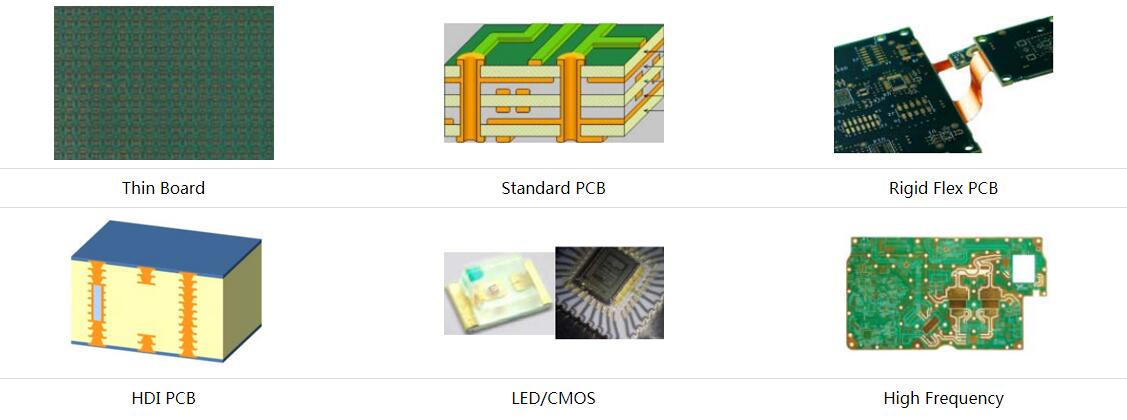
Wintech provides PCB design and layout, quick-turn prototyping, and PCB fabrication and assembly services, including multilayer rigid PCBs, HDI, flexible printed circuits, rigid-flex circuits, semi-flex circuits, RF boards, and microvia structures. Its stated manufacturing range includes 2–70 layer PCBs, from prototypes through mass production. The right project fit should be confirmed against the actual stack-up, material grade, tolerances, and volume.
Wintech PCB Manufacturing Services
For projects involving polyimide flex circuits, rigid-flex designs, HDI, or multilayer PCB assemblies, involve the manufacturer during the design stage. Early DFM feedback can identify material, stack-up, bend-radius, registration, and assembly risks before they become production issues.
Explore Wintech PCB manufacturing and assembly services
2–70 layersPrototype to mass productionFlex and rigid-flexHDI and multilayer
Wintech's engineering capability, manufacturing services, and supply chain services are relevant starting points when assessing a project that needs coordinated engineering, fabrication, and sourcing. For supplier due diligence, compare technical fit and quality controls rather than relying on a general supplier ranking; our guide to PCB manufacturers in China provides additional sourcing context.
Common Mistakes When Selecting Polyimide PCB Materials
- Choosing polyimide only because of its temperature reputation. If the board does not need flexibility or enhanced thermal capability, the premium may deliver little value.
- Assuming all polyimide laminates perform identically. Film grade, adhesive, copper, thickness, and protective layers change the finished circuit's behavior.
- Ignoring moisture absorption. Material storage, conditioning, and process controls should be discussed with the fabricator, especially for fine-pitch and multilayer designs.
- Designing a dynamic flex zone like a static flex zone. Repeated movement requires a fatigue-oriented stack-up and routing strategy.
- Putting vias or components in the bend area without review. These features can create stress concentrations and reliability risks.
- Comparing supplier quotations without matching specifications. Different coverlays, copper weights, adhesives, tolerances, and tests can make apparently similar prices incomparable.
- Leaving the manufacturer out until after layout completion. Early design-for-manufacturing review is usually less expensive than correcting a poor stack-up after release.
When a board is damaged, the repair decision also depends on the failure location and construction. A burnt or delaminated flexible circuit may not be safely recoverable through a simple patch. See our practical discussion of whether a burnt circuit board can be repaired for the factors that influence repair versus replacement.
Expert Recommendation: When Is Polyimide Worth the Investment?
Our recommendation is to select polyimide when it solves a defined mechanical, thermal, or packaging problem that a conventional rigid PCB cannot solve efficiently. It is particularly compelling for flex circuits that must move, rigid-flex assemblies that replace multiple connectors and cables, and electronics exposed to demanding thermal conditions.
For beginners, start with the mechanical requirement: does the circuit need to bend, fold, or fit into a constrained shape? If yes, evaluate a polyimide flex construction with a PCB manufacturer before finalizing the layout. If no, compare the required thermal and electrical performance against an appropriate FR-4 or specialized rigid laminate before paying for polyimide.
For commercial users, calculate total installed cost rather than bare-board price. A flexible circuit that removes connectors, reduces manual wiring, or simplifies assembly may justify a higher unit cost. For heavy-duty applications, insist on a documented environmental profile, material data, process controls, and reliability testing appropriate to the actual duty cycle.
In our view, the best polyimide PCB is not the one with the most impressive material specification. It is the one whose complete construction is matched to the product's operating conditions and can be manufactured consistently at the required volume and cost.
Quick Summary: 5 Properties of Polyimide PCB Materials
| Property | What It Means | Where It Helps | What to Verify |
|---|---|---|---|
| Thermal stability | Maintains useful properties under elevated temperatures | Automotive, aerospace, industrial, and compact electronics | Continuous and peak temperature limits of the complete stack-up |
| Flexibility and fatigue resistance | Enables flexible circuit layouts and designed bending | Wearables, hinges, cameras, medical devices, and rigid-flex assemblies | Bend radius, cycle count, copper type, thickness, and routing |
| Dielectric performance | Provides electrical insulation and supports circuit separation | Multilayer flex, compact electronics, and selected RF designs | Dk, Df, dielectric thickness, frequency, and impedance targets |
| Chemical resistance | Can tolerate a range of chemical exposures | Industrial equipment and electronics exposed to cleaning or process fluids | Exact chemical, concentration, temperature, duration, and layer compatibility |
| Dimensional stability | Helps maintain geometry through processing and environmental changes | Fine-pitch, multilayer, HDI, and rigid-flex circuits | Moisture control, registration, lamination, and process capability |
Bottom line: Polyimide is a high-value PCB material when flexibility, thermal demands, or compact integration are essential. It is not automatically the most economical or electrically optimal choice for every board. Define the application first, specify the complete laminate construction, and involve a capable fabricator early.
Frequently Asked Questions About Polyimide PCB Materials
1. What are the five main properties of polyimide PCB materials?
The five key properties are high thermal stability, flexibility and mechanical fatigue resistance, strong dielectric insulation, chemical resistance, and dimensional stability. The actual performance depends on the polyimide grade and the complete PCB construction.
2. Is polyimide better than FR-4 for PCBs?
Not in every application. Polyimide is generally more suitable for flexible and rigid-flex circuits and selected high-temperature designs. FR-4 is usually more cost-effective for conventional rigid boards that do not need those capabilities.
3. Can polyimide PCBs withstand high temperatures?
Polyimide is known for strong thermal stability, but the allowable temperature depends on the film grade, copper, adhesive, coverlay, and other materials in the finished board. Check the complete construction's data and operating limits rather than relying on the base film alone.
4. Are polyimide PCBs suitable for repeated bending?
They can be, provided the circuit is designed for dynamic flexing. Bend radius, copper type and thickness, layer count, trace routing, and coverlay design all affect fatigue life. A flexible substrate by itself does not guarantee long-term repeated-bend reliability.
5. Do polyimide PCB materials absorb moisture?
Yes. Polyimide can absorb moisture, and moisture behavior should be considered during storage, fabrication, and operation. The effect varies with material construction and environmental conditions, so follow the laminate supplier's handling and processing guidance.
6. Are polyimide PCBs suitable for high-frequency applications?
They can be used in selected high-frequency designs, but suitability depends on dielectric constant, dissipation factor, frequency, copper roughness, thickness, and stack-up. Request electrical data for the exact laminate construction and validate impedance and signal loss for the application.
7. Why are polyimide PCBs more expensive?
They often require higher-cost materials and more specialized fabrication processes than standard rigid FR-4 boards. Flexible or rigid-flex designs may also need additional engineering, coverlay, stiffeners, and tighter process controls. The added cost can be worthwhile if it reduces connectors, wiring, assembly labor, or product size.
8. What industries commonly use polyimide PCBs?
Common applications include aerospace, automotive electronics, medical devices, industrial equipment, telecommunications, cameras, consumer electronics, and wearables. These sectors use polyimide when flexible construction, thermal capability, or compact packaging is important.
9. What should I provide when requesting a polyimide PCB quotation?
Provide Gerber or manufacturing data, stack-up, material requirements, copper weights, finished thickness, coverlay and stiffener details, bend radius, expected flex cycles, electrical requirements, operating environment, quantity, and inspection criteria. For rigid-flex or HDI designs, request a DFM review before production.
10. Can Wintech manufacture flexible and rigid-flex PCBs?
Wintech lists flexible printed circuits and HDI rigid-flex circuits among its PCB manufacturing capabilities, alongside multilayer rigid PCBs, HDI, RF, and other constructions. Project feasibility should be confirmed against the required polyimide material, layer count, tolerances, stack-up, and production volume.
References
- DuPont – Kapton Polyimide Film. Manufacturer information on polyimide film applications and material characteristics.
- IPC – Association Connecting Electronics Industries. Industry standards and technical resources for printed circuit board design, materials, fabrication, and acceptance.
- NASA Technical Reports Server. Technical research archive containing aerospace materials and electronics engineering publications.
Planning a flexible or rigid-flex PCB project? Contact Wintech about PCB design, fabrication, prototyping, and assembly. Share your stack-up, operating conditions, bend requirements, and production target so the manufacturing team can assess the right construction.


