

How Integrated Electronics Manufacturing Simplifies the Supply Chain
Managing an electronics hardware program through a fragmented network of disconnected vendors is an operational nightmare that bleeds corporate capital. Picture the conventional hardware workflow: your engineering team orders bare printed circuit boards from one fabricator, procures active semiconductor reels from three separate distributors, ships passive components to an independent assembly house, subcontracts aluminum enclosure milling to a local machine shop, and tasks an external harness maker with custom wiring looms. When the final production batch arrives at your testing warehouse and the populated circuit board fails to seat properly against the milled mounting standoffs, chaos ensues. The assembly house blames the board fabricator for thermal warpage, the machinist claims their CNC tolerances matched the drawing, and your project delivery date slips by eight weeks while inventory carrying costs escalate. Understanding how integrated electronics manufacturing simplifies the supply chain is no longer just a procurement tactic; it is the definitive strategy that separates agile, high-margin hardware companies from organizations paralyzed by logistics bottlenecks and inter-vendor finger-pointing.
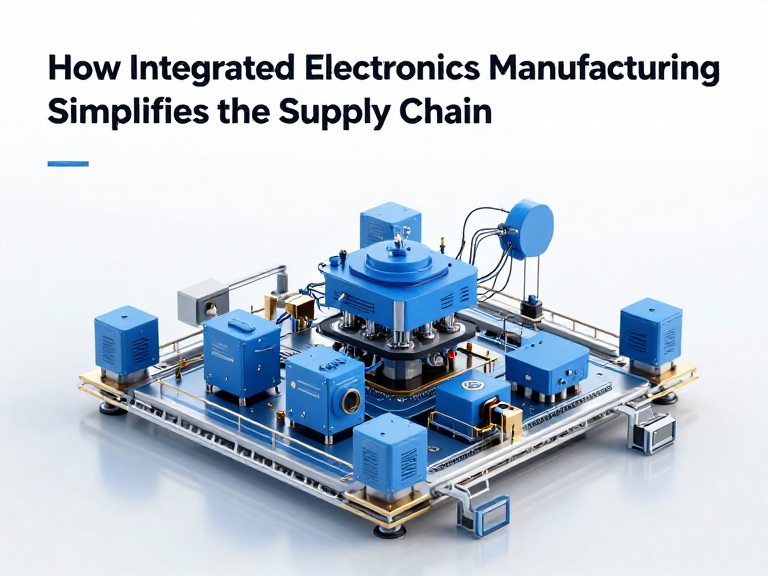
Quick Answer: How Integrated Electronics Manufacturing Resolves Supply Chain Complexity
Integrated electronics manufacturing unifies every stage of hardware realization—from bare board fabrication and component sourcing to surface-mount assembly (SMT), precision metal machining, custom plastic molding, wire harnessing, and final electro-mechanical box builds—under a single, accountable manufacturing umbrella. By replacing fragmented, multi-vendor purchasing networks with an integrated partner, original equipment manufacturers (OEMs) eliminate inter-facility shipping delays, reduce procurement overhead by up to 40%, optimize design-for-manufacturing (DFM) iterations concurrently, and secure end-to-end quality accountability. Working with an established turnkey solution provider like Wintech transforms disconnected logistics chains into a synchronized, single-purchase-order workflow that accelerates time-to-market while defending gross profit margins.
Article Directory
- What Is Integrated Electronics Manufacturing and How Does It Function?
- Quick Summary Table: Disconnected Sourcing vs. Integrated Manufacturing
- The Core Mechanisms: How Integration Streamlines Supply Chains
- Featured Manufacturing Partner: Wintech Comprehensive EMS Solutions
- Direct Operational Comparison: Sourcing Architecture Breakdown
- Pros and Cons of Adopting Integrated Electronics Manufacturing
- Who Must Transition to Integrated Manufacturing (And Who Can Stay Fragmented)
- Costly Sourcing Mistakes Hardware Companies Make with Disconnected Suppliers
- Essential Sourcing Checklist: Auditing an Integrated Manufacturing Partner
- Expert Procurement Verdict & Strategic Roadmap
- Frequently Asked Questions
- Authoritative Regulatory & Industry Standards
What Is Integrated Electronics Manufacturing and How Does It Function?
To grasp the profound commercial impact of integrated electronics manufacturing, one must trace the structural evolution of the electronic manufacturing services (EMS) sector. Historically, the hardware industry relied on narrow Contract Equipment Manufacturers (CEMs) that focused strictly on single disciplines—such as stuffing through-hole components into boards or pressing metal plates. As consumer, medical, and industrial electronics grew in complexity, leading facilities evolved into Original Design Manufacturers (ODMs) and vertically integrated turnkey partners capable of orchestrating full-lifecycle hardware realization.
True integrated electronics manufacturing transcends basic contract circuit assembly. It merges distinct industrial engineering branches into a continuous, data-driven production stream:
- Substrate & Interconnect Fabrication: High-precision PCB Manufacturing spanning high-density interconnect (HDI), high-layer count backplanes, and rigid-flex laminates.
- Component Sourcing & Surface-Mount Assembly: Automated high-speed placement lines executing advanced PCB Assembly & PCBA SMT, fine-pitch ball grid array (BGA) placement, 01005 passives, and 3D automated optical inspection (AOI).
- Mechanical Enclosure Fabrication: In-house tooling including custom Plastic Molding for aesthetic industrial casings and sub-millimeter Metal Precision Machining for structural frames and heat sinks.
- Electrical Interconnects & Industrial Wiring: Fabrication of custom Cable Harness & Assembly looms alongside heavy-duty Cabinet & Panel PLC Wiring for industrial automation controls.
- Full Electro-Mechanical Integration: Complete Turnkey Box Build and rigorous Electro-Mechanical Assembly, routing internal wiring, securing thermal interface materials, closing housings, and conducting final functional burn-in testing.
From our experience on production facility floors, integration is not simply about housing disparate equipment under one roof; it is about shared engineering intelligence. When the bare board engineer, the SMT process specialist, and the tooling mold designer share the same Enterprise Resource Planning (ERP) database and quality management system, design revisions occur in minutes rather than across weeks of fragmented email chains.
Quick Summary Table: Disconnected Sourcing vs. Integrated Manufacturing
| Operational Parameter | Fragmented Multi-Vendor Sourcing | Integrated Electronics Manufacturing | Commercial & Strategic Impact |
|---|---|---|---|
| Vendor Management Overhead | High; managing 8 to 15 distinct supplier contracts | Minimal; single point of contact and unified purchase order | Cuts administrative procurement hours by up to 60% |
| Design-for-Manufacturing (DFM) | Sequential; changes bounce between disconnected vendors | Concurrent; collaborative cross-discipline reviews | Prevents costly post-tooling re-spins and mold modifications |
| Logistics & In-Transit Risk | High; multiple cross-border freight legs and customs handoffs | Negligible; sub-assemblies move across internal work cells | Eliminates inter-facility shipping delays, damage, and tariffs |
| Quality Control Accountability | Fragmented; vendors dispute responsibility for defects | Absolute; single partner owns complete functional yield | Enforces zero-defect accountability under unified ISO standards |
| NPI to Production Velocity | Protracted; 16 to 24 weeks average transition | Rapid; 6 to 10 weeks streamlined conversion | Captures first-to-market commercial revenue advantages |
| Inventory & Buffer Stock Costs | Excessive; buffer inventory required at every vendor gate | Lean; synchronized JIT internal scheduling | Unlocks working capital trapped in work-in-progress (WIP) stock |
The Core Mechanisms: How Integration Streamlines Supply Chains
1. Elimination of the Multi-Vendor Friction Layer
In traditional hardware procurement, a standard electronic controller requires issuing separate purchase orders for the bare PCB, passive chip components, active microcontrollers, molded plastic front bezels, extruded aluminum heat sinks, internal wiring harnesses, fasteners, and final packaging cartons. Each vendor enforces their own minimum order quantities (MOQs), payment terms, credit limits, lead time buffers, and shipping carriers.
If the microcontroller distributor experiences a four-week shipping delay, the assembled circuit boards sit idle in a warehouse. Meanwhile, the plastic injection shop completes the housings and demands immediate payment, while the cable harness shop pushes their delivery date because their incoming connector stock was delayed. By contrast, integrated electronics manufacturing replaces this operational gridlock with a unified master production schedule. The integrated facility coordinates material intake dynamically, absorbing internal micro-delays without passing administrative chaos back to your engineering team.
2. Concurrent Engineering and Collaborative DFM Optimization
Sequential product development is the primary culprit behind blown hardware launch budgets. Under the fragmented model, an electrical engineer designs a PCB layout, sends it to an assembly shop, and waits for a prototype. Only after populating the board do they discover that an electrolytic capacitor sits two millimeters too high, colliding with the internal ribbing of the die-cast enclosure engineered by a completely separate mechanical vendor.
In an integrated environment, early-stage New Product Introduction NPI protocols run concurrently. Electrical engineers, SMT technicians, and mechanical tooling specialists review the complete assembly model inside shared CAD/CAM platforms. Mechanical engineers optimize thermal relief pathways on the circuit board to align with milled aluminum heatsink fins in real time. Tooling specialists identify draft angles on plastic housings that prevent board-mounting stress before metal molds are cut. This collaborative engineering approach catches fatal tolerance stack-up errors during digital drafting rather than during pilot assembly.
3. Mitigation of Counterfeit Components and Sourcing Vulnerabilities
Component obsolescence and grey-market counterfeit parts present existential threats to mission-critical hardware. When procurement teams scramble across open-market brokers to source scarce chips, they expose their products to sanded down, remarketed, or defective components that fail unpredictably in the field.
Established integrated manufacturing partners maintain enterprise-grade supply agreements directly with franchised silicon manufacturers and authorized global distributors. Because they procure massive aggregate component volumes across their client portfolio, integrated facilities command priority supply allocations during global semiconductor crunches. Furthermore, in-house testing laboratories utilize X-ray inspection, decapsulation, and automated electrical validation to guarantee component authenticity before parts touch an SMT feeder.
4. Total Quality Traceability and Single-Point Accountability
When an assembled product fails final testing in a multi-vendor setup, assigning responsibility is nearly impossible. The board assembler claims the bare circuit board suffered from excessive surface roughness that ruined solder joint wetting. The PCB fabricator counters that the assembler used an aggressive reflow profile that delaminated the substrate. The enclosure manufacturer claims the board warped during final screw torquing.
With integrated electronics manufacturing, this finger-pointing disappears completely. The integrated partner holds comprehensive, end-to-end responsibility for final system functionality. When you mandate compliance with international assembly benchmarks such as IPC-A-610 Class 2 or Class 3, the integrated manufacturer monitors solder paste deposition, component placement accuracy, optical inspection metrics, and torque calibrations internally. If a yield drop occurs, internal root-cause corrective action (RCCA) teams trace the failure to its origin without administrative delays or disputed repair invoices.
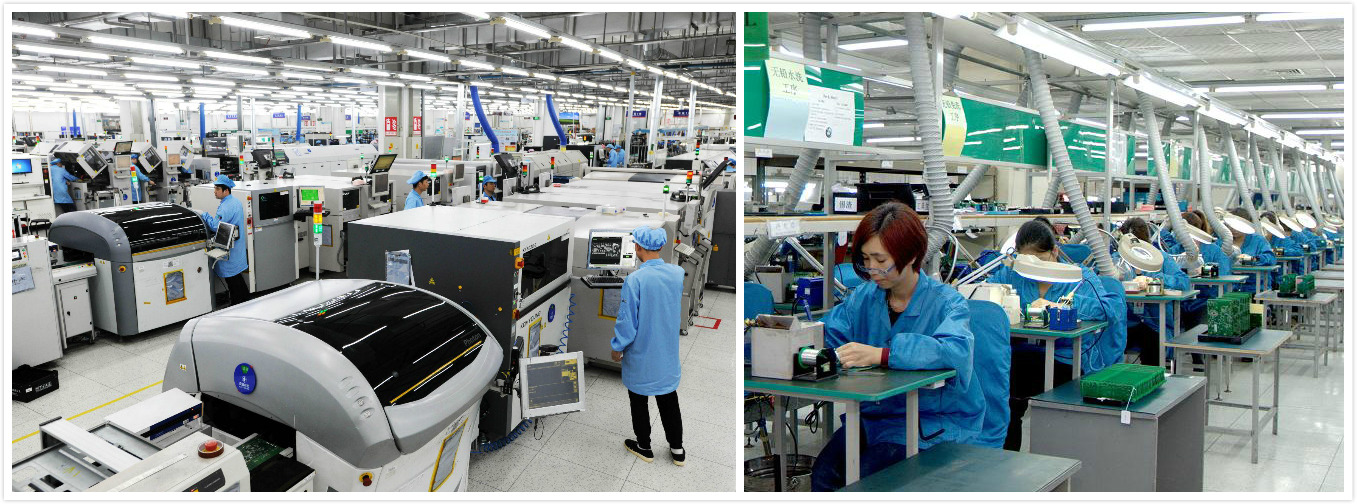
Integrated Manufacturing Partner: Wintech Comprehensive EMS Solutions
Navigating modern hardware development demands an asset-backed contract manufacturer with verified multi-disciplinary execution. Wintech delivers end-to-end, high-reliability Electronics Manufacturing Services (EMS), bridging the gap between digital schematic concepts and volume-ready commercial products.
| Circuit Manufacturing | Advanced multi-layer rigid, flex, and HDI fabrication via dedicated PCB Manufacturing lines |
| SMT Assembly Capabilities | High-speed automated surface-mount assembly, 01005 passives, BGA/QFN, and PCB Assembly & PCBA SMT |
| Mechanical Integration | In-house Metal Precision Machining and custom Plastic Molding tooling cells |
| Specialized Systems | High-density industrial Backplanes & Sever Chasis and custom rack enclosures |
| Turnkey Execution | End-to-end Turnkey Box Build, functional burn-in testing, and lifecycle packaging |
Procurement Recommendation: Review our complete technical capabilities on the Electronics Manufacturing Services Overview portal to evaluate how single-source integration accelerates product launches.
Direct Operational Comparison: Sourcing Architecture Breakdown
| Operational Metric | Fragmented Multi-Vendor Sourcing | Hybrid Sourcing (PCBA + External Mech) | Integrated Electronics Manufacturing |
|---|---|---|---|
| Purchase Orders per SKU | 10 to 25 separate POs | 4 to 7 separate POs | 1 Consolidated Turnkey PO |
| Time-to-Market (NPI Phase) | Slow (16 to 24 Weeks) | Moderate (12 to 16 Weeks) | Fast (6 to 10 Weeks) |
| Internal Freight Overhead | High; multiple international shipping legs | Moderate; shipping boards to mech assemblers | Zero internal freight; sub-units move cell-to-cell |
| Tolerance Mismatch Risk | Severe; independent tooling calibrations | Moderate; board-to-enclosure fit issues | Minimal; integrated mechanical verification |
| Traceability & Regulatory Audits | Fragmented; assembling records from 10 shops | Mixed; dual-system compliance tracking | Seamless; unified device history records (DHR) |
| Lifecycle Engineering Support | None; individual shops offer no holistic insight | Limited to basic circuit updates | Comprehensive; proactive component obsolescence |
Pros and Cons of Adopting Integrated Electronics Manufacturing
| Procurement Approach | Commercial & Technical Advantages | Operational Trade-Offs & Boundaries |
|---|---|---|
|
Integrated Turnkey Manufacturing (Full-Scope EMS Execution) |
|
|
|
Fragmented Disconnected Sourcing (Specialist Piece-Rate Buying) |
|
|
Who Must Transition to Integrated Manufacturing (And Who Can Stay Fragmented)
Allocating capital and delegating manufacturing authority requires careful operational analysis. While integrated electronics manufacturing delivers immense competitive advantages to high-growth programs, certain business profiles may still function with basic fragmented contracts.
Who Must Adopt Integrated Electronics Manufacturing:
- High-Growth Hardware Startups and Scale-Ups: Emerging hardware ventures cannot afford to staff an eight-person internal procurement, logistics, and quality assurance department. Partnering with an integrated manufacturer provides immediate tier-one operational scale, allowing core teams to focus exclusively on product design, software, and commercial sales.
- Medical Device, Aerospace, and Industrial Automation OEMs: Sectors governed by strict regulatory frameworks (such as ISO 13485 or AS9100) demand unbroken Device History Records (DHR) and absolute component lot traceability. Using disconnected shops to build sub-assemblies creates audit vulnerabilities that stall regulatory clearances. Utilizing specialized Cabinet & Panel PLC Wiring and cleanroom assembly in an integrated facility guarantees seamless regulatory compliance.
- Complex Electro-Mechanical System Developers: If your product incorporates high-power backplanes, custom extruded aluminum enclosures, internal liquid cooling loops, or intricate wiring harnesses, physical tolerance stack-up will destroy disconnected production runs. Sourcing complex Enclosures & Racks & Frames alongside PCBA assembly under one roof guarantees physical fit.
Who Can Continue Using Fragmented Sourcing:
- Academic Research Labs and Hobbyist Developers: If your project involves building three benchtop prototypes with non-commercial timelines, you do not need enterprise integration. Ordering simple boards from hobbyist fabricators and assembling them with hand-soldering irons is perfectly adequate.
- Commodity Single-Component Manufacturers: If your business manufactures a bare unpopulated copper coil, a basic wire lead, or a simple stamped steel bracket with zero electrical intelligence, specialized single-discipline job shops remain cost-effective.
Costly Sourcing Mistakes Hardware Companies Make with Disconnected Suppliers
Operational Advisory: The most catastrophic mistake hardware procurement directors make is calculating cost solely on piece-part unit quotes while ignoring landed logistics, vendor management overhead, and yield loss costs. A circuit board quoted at $12 from a disconnected shop easily ends up costing $28 once inter-facility freight, quarantine buffers, and assembly re-spins are factored in.
- Treating PCB Fabrication and PCB Assembly as Independent Silos: Procurement teams frequently award board fabrication to Shop A and assembly to Shop B to capture fractional cent savings. When solder bridging occurs across 0.4mm pitch QFN packages, Shop B blames Shop A's solder mask registration, while Shop A blames Shop B's stencil aperture design. Sourcing through an integrated PCB Assembly & PCBA SMT flow eliminates this division entirely.
- Overlooking Enclosure and Harness Clearances in Early Prototyping: Designing a custom circuit board without verifying real-world bend radii for internal wiring looms leads to pinched insulation, electrical shorts, and assembly gridlocks. Prototyping through agile programs like Quick Turn Fast PCB Prototype Assembly within an integrated ecosystem ensures that cable harnesses and mechanical enclosures are validated concurrently.
- Failing to Account for Tooling Maintenance and Wear Overruns: Commissioning plastic molds or die-casting tooling from low-cost, independent shops without establishing maintenance contracts leaves OEMs vulnerable. When injection molds flash or wear out after 50,000 shots, the customer must pay expensive re-tooling fees. Integrated partners maintain in-house tooling to protect part tolerances across long production runs.
- Neglecting Post-Production Lifecycle Services: Disconnected contract shops abandon products the moment finished cartons leave their loading dock. When warranty returns or field updates occur, OEMs have nowhere to turn. An integrated manufacturer provides dedicated Repair And Rework pipelines, component harvesting, and re-flashing services, keeping product lifecycles cost-effective.
Essential Sourcing Checklist: Auditing an Integrated Manufacturing Partner
Before entering into a Master Services Agreement (MSA) with any prospective integrated electronics manufacturer, procurement and engineering leaders must verify four core operational capabilities:
1. Verified In-House Assets vs. Broker Fronts
The electronics contract manufacturing market is crowded with sales agencies masquerading as vertically integrated factories. These brokers take turnkey orders, quietly subcontract the PCBA to one facility, the metal to another, and the wiring to a third, pocketing an arbitrary 25% margin while introducing the exact multi-vendor communication friction you sought to eliminate. Demand a live video walkthrough of the factory floor. Verify that SMT placement lines, CNC milling centers, plastic injection presses, and testing cells operate within company-owned facilities.
2. Quality Management Accreditations and Inspection Technology
Confirm that the manufacturer maintains active, third-party audited certifications matching your industry sector:
- ISO 9001:2015: Baseline quality management systems covering standard commercial electronics.
- ISO 13485:2016: Mandatory medical device manufacturing standards requiring comprehensive risk management and cleanroom controls.
- IATF 16949: Automotive quality benchmarks enforcing zero-defect methodologies and advanced product quality planning (APQP).
- IPC-A-610 Class 3: High-performance electronic assemblies where uninterrupted service is critical (defense, medical, industrial controls).
3. Engineering Depth and DFM/DFT Competence
A true integrated partner functions as an extension of your research and development department. Examine their internal Engineering Design capabilities. Can their staff perform thermal simulation modeling, signal integrity simulations, circuit layout optimization, and test fixture design? A contract partner that merely builds what you draw without offering constructive DFM feedback is an order taker, not an integrated manufacturing partner.
4. Transparency in Bill of Materials (BOM) and Supply Chain Telemetry
Insist on open-book transparency for critical electronic components. Your manufacturing partner should provide real-time updates on component lifecycles, lead times, end-of-life (EOL) notifications, and recommended drop-in replacements for volatile silicon. Transparency prevents surprise production halts when a key passive or semiconductor becomes constrained.
Expert Procurement Verdict & Strategic Roadmap
In our professional assessment, the historical model of managing disconnected, fragmented vendor networks for complex electronic hardware is obsolete. The hidden costs of vendor coordination, inter-facility shipping, multi-tiered markups, and delayed launch dates far outweigh any minor piece-part savings achieved by shopping individual components across dozens of unvetted workshops.
For organizations engineering commercial, industrial, medical, or telecommunications hardware, transitioning to integrated electronics manufacturing is the most reliable way to streamline operations. Consolidating bare board fabrication, high-speed SMT assembly, precision mechanical machining, cable harnessing, and turnkey box build integration under an experienced, asset-backed partner like Wintech fundamentally resets your operational trajectory. You gain single-point accountability, compress development timelines from months to weeks, eliminate inter-vendor disputes, and secure the supply chain resilience necessary to scale your hardware profitably in competitive global markets.
Frequently Asked Questions
Integrated electronics manufacturing consolidates bare board fabrication, component kitting, SMT assembly, wire harnessing, and mechanical enclosure integration under one operational umbrella. This eliminates inter-vendor transit buffers, reduces multi-tiered purchasing handoffs, and enables concurrent engineering reviews, cutting total production cycles by 30% to 50%.
Traditional Electronic Manufacturing Services (EMS) typically focus exclusively on circuit board assembly (PCBA). In contrast, integrated electronics manufacturing extends through full-lifecycle engineering, including bare PCB manufacturing, precision CNC machining, plastic injection tooling, cable harnesses, final electro-mechanical box build assembly, and functional system testing.
When a field failure or assembly misfit occurs in a multi-vendor supply chain, the PCB fabricator, SMT assembler, and enclosure molder invariably blame one another. An integrated manufacturing partner takes single-point accountability for the complete bill of materials (BOM), ensuring internal root-cause resolution without cost shifting or project delays.
Yes. While enterprise OEMs gain massive volume economies of scale, SMEs benefit even more by eliminating the overhead of managing 8 to 15 disparate suppliers. An integrated contract partner reduces administrative procurement hours, minimizes freight consolidation charges, and catches design-for-manufacturing (DFM) errors before expensive tooling investments are committed.
Authoritative Regulatory & Industry Standards
- IPC International: IPC-A-610 Acceptability of Electronic Assemblies & J-STD-001 Requirements for Soldered Electrical and Electronic Assemblies
- International Organization for Standardization (ISO): ISO 9001:2015 Quality Management Systems & ISO 13485:2016 Medical Devices
- IEEE Standards Association: Engineering Guidelines for High-Reliability Electronic Systems and Supply Chain Continuity


