

6 Best PCB Glue for Electronics: The Engineering Sourcing and Assembly Guide
Too many hardware teams and assembly technicians treat adhesive selection as an afterthought, reaching for whatever tube of hardware-store silicone, hot melt, or generic cyanoacrylate sits on the workbench. In production electronics, that casual approach leads directly to field failures. An uncalibrated adhesive will leach corrosive acetic acid into copper traces, bridge fine-pitch solder joints with ionic contaminants, or tear surface-mount pads straight off the FR-4 laminate when thermal expansion cycles kick in. Sourcing the best pcb glue for electronics is not about finding an all-purpose sticky paste; it is about matching chemical polymer bases to thermal expansion coefficients, dielectric breakdown limits, and production cycle times.
In high-reliability electronics manufacturing, adhesives fulfill strict structural and electrical functions. They anchor heavy electrolytic capacitors against harmonic vibration, bridge air gaps between power MOSFETs and extruded aluminum heatsinks, protect fine-pitch ball grid arrays (BGAs) from shock, and seal enclosures against moisture intrusion. We analyze the six premier PCB adhesive chemistries deployed in commercial manufacturing, providing clear engineering criteria to keep your circuit boards reliable, serviceable, and structurally sound.
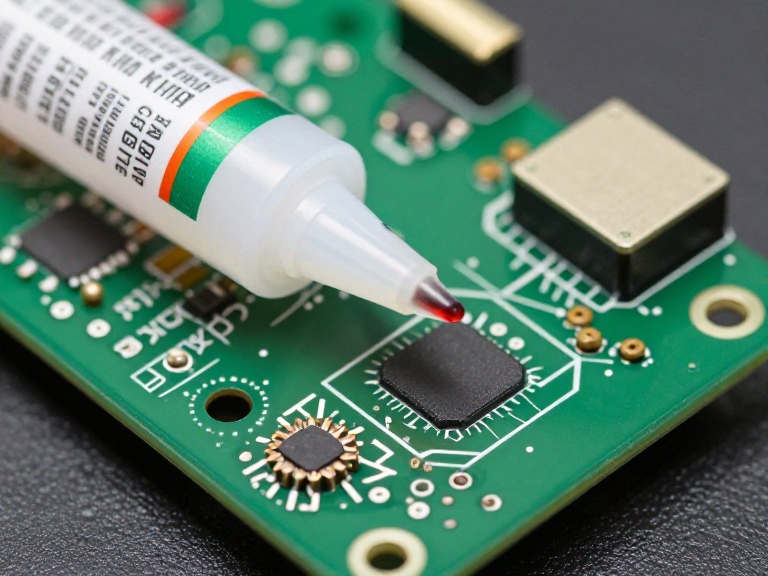
Quick Answer: Which Is the Best PCB Glue for Electronics?
There is no single universal adhesive for circuit boards. For permanent structural staking of heavy through-hole components and pad repairs, two-part electronics-grade epoxy is the undisputed standard due to its high shear strength and resistance to solder reflow temperatures. For high-heat power supplies, flexible circuits, and vibration dampening in automotive modules, non-corrosive neutral-cure silicone (RTV) is mandatory. For automated high-speed double-sided SMT assembly, thermosetting SMT red epoxy glue holds bottom components securely during wave soldering. For rapid wire tacking and jumper repairs, UV-curable acrylic adhesive cures in seconds under a 365nm lamp. Avoid consumer hardware-store silicones containing acetoxy cure mechanisms; they emit acetic acid that corrodes copper leads and causes latent circuit shorts.
Table of Contents
- What PCB Glue Is and How Chemical Bonding Operates on Circuit Boards
- Quick Summary Table: The 6 Best PCB Adhesive Classes
- In-Depth Evaluation: 6 Best PCB Glue Types for Electronics
- Comprehensive Adhesive Chemistry Comparison Matrix
- Pros and Cons of Rigid Epoxies vs. Flexible Silicones
- Who Needs Structural Bonding vs. Who Needs Flexible Dampening
- Integrated Engineering Solutions: Wintech PCB Design & Assembly
- Costly Mistakes Engineers Make When Applying PCB Adhesives
- Critical Buying and Sourcing Considerations for Production
- Expert Recommendation and Assembly Sourcing Verdict
- Frequently Asked Questions (FAQ)
- Authoritative References
What PCB Glue Is and How Chemical Bonding Operates on Circuit Boards
PCB glue refers to an engineered class of non-conductive (or selectively conductive) polymeric bonding agents designed specifically for electronic substrates. Unlike domestic adhesives, electronic-grade formulations must possess exceptional dielectric strength (preventing current leakage between high-voltage traces), low outgassing characteristics (preventing chemical film deposits on nearby optical sensors or relay contacts), and minimal ionic impurities like chlorine, sodium, and potassium, which cause dendrite growth and galvanic corrosion in the presence of ambient humidity.
How it works comes down to surface energy and molecular cross-linking. A circuit board consists of multiple materials: woven glass-reinforced epoxy (FR-4), polyimide flex layers, copper foil, solder mask inks, tinned component terminations, and molded epoxy IC bodies. The adhesive must wet these varying surface energies, form tight mechanical and chemical bonds, and cure via heat, moisture, UV radiation, or chemical catalysts into a durable cross-linked polymer network.
From our experience on production lines, matching the adhesive's Coefficient of Thermal Expansion (CTE) to the surrounding components is critical. If a rigid adhesive expands three times faster than an adjoining ceramic BGA package during operational thermal cycling, the sheer mechanical stress will tear solder joints apart. The best pcb glue for electronics balances shear adhesion with enough elasticity to absorb internal mechanical strains.
Quick Summary Table: The 6 Best PCB Adhesive Classes
The table below provides a quick operational reference to the six primary PCB adhesive chemistries, their curing mechanisms, and their primary manufacturing roles:
| Adhesive Category | Primary Polymer Chemistry | Standard Curing Method | Temperature Range | Optimal Electronics Application |
|---|---|---|---|---|
| 1. Structural Electronics Epoxy | Two-Part Bisphenol / Amine | Room temp (24h) or Heat cure | -55°C to 150°C+ | Heavy component staking, broken trace/pad repair, potting |
| 2. Neutral-Cure RTV Silicone | Alkoxy / Oxime Polysiloxane | Atmospheric moisture cure | -60°C to 200°C+ | Vibration dampening, tall cap staking, thermal expansion zones |
| 3. SMT Thermoset Red Glue | One-Part Latent Epoxy | Thermal oven (100°C–150°C) | -40°C to 130°C | Holding passive chips on wave-solder bottom layers |
| 4. UV-Curable Acrylic Adhesive | Photo-initiated Urethane Acrylate | UV light (365nm / 405nm, seconds) | -40°C to 125°C | Wire tacking, jumper wire locking, fast bench rework |
| 5. Thermally Conductive Adhesive | Ceramic / Metal-filled Epoxy/Silicone | Room temp or Heat cure | -40°C to 180°C | Bonding heatsinks, power LED modules, driver FETs |
| 6. Electrically Conductive (ECA) | Silver-Flake Loaded Epoxy | Heat cure or Room temp | -50°C to 140°C | Heat-free component attachment, flexible circuitry, RF shields |
In-Depth Evaluation: 6 Best PCB Glue Types for Electronics
1. Two-Part Structural Electronics Epoxy
When you need absolute mechanical hold that will not budge under shock or thermal stress, two-part structural epoxy is the industry benchmark. Composed of an epoxy resin and a specialized polyamine or polyamide hardener, it cures via an exothermic chemical reaction into a rigid thermoset solid. It is completely impervious to isopropyl alcohol, flux removers, conformal coating solvents, and standard soldering reflow profiles.
In our testing, two-part epoxy is the premier solution for anchoring heavy inductors, high-mass transformers, and structural connectors that experience high mating cycles. It is also the only reliable chemical system for repairing torn solder pads or rebuilding damaged laminate substrates during precision board salvage. Its primary operational limitation is rigidity: because cured epoxy has a very high elastic modulus, using it to bridge components with mismatched thermal expansion coefficients can induce stress fractures on adjacent solder joints. Furthermore, rework is destructive; removing cured epoxy requires temperatures exceeding 250°C, which often destroys nearby circuit traces. When executing complex mechanical builds, review our engineering guidelines for Electro-Mechanical Assembly to integrate proper mechanical fasteners alongside structural bonding.
2. Neutral-Cure RTV Silicone (Electronic Grade)
Silicone is the undisputed king of flexibility, vibration absorption, and broad thermal survival. Room Temperature Vulcanizing (RTV) silicones cure by drawing moisture out of ambient air, transforming into a durable, rubbery elastomer that operates comfortably from -60°C up to 200°C without cracking, melting, or stiffening.
In most professional situations involving automotive ECUs, outdoor LED controllers, or high-vibration power converters, neutral-cure silicone is our primary recommendation. Tall electrolytic capacitors act like inverted pendulums; without staking, harmonic road vibrations will snap their leads at the circuit board within months. Applying a thick fillet of silicone between the capacitor body and the board damps vibration energy completely. Critical caveat: you must specify an alkoxy or oxime neutral-cure formulation. Never use hardware-store silicone that smells like vinegar (acetoxy cure); the acetic acid byproduct chemically attacks copper traces and solder pads, ruining your assembly.
3. SMT Thermoset Red Glue (Surface Mount Adhesive)
Surface-mount thermoset adhesive—colloquially known across production floors as SMT red glue—is a specialized, one-part latent epoxy paste. It is engineered for a single high-volume manufacturing workflow: double-sided mixed-technology circuit board assembly. High-speed automated dispensers or stencil printers deposit small dots of red glue onto the circuit board between passive component pads. Pick-and-place nozzles seat the 0603 or 0805 components directly into the wet glue dot.
The board passes through a dedicated curing oven (or the first zone of a reflow tunnel) at 100°C to 150°C, cross-linking the glue into a solid polymer anchor in 60 to 90 seconds. When the board is flipped upside down to pass through a turbulent wave soldering bath, the cured red glue prevents bottom-side components from falling into the molten solder pot. For commercial users managing high-volume runs, red glue provides high green strength (preventing component movement before curing) and thermal endurance during molten wave soldering.
4. UV-Curable Acrylic Adhesive
In electronics rework stations, prototyping labs, and high-speed assembly benches, waiting hours for an epoxy or silicone to cure kills production velocity. UV-curable adhesives use liquid acrylic or urethane-acrylate oligomers mixed with photo-initiators. When exposed to focused ultraviolet radiation (typically 365nm to 405nm), the photo-initiators generate free radicals that trigger polymerization across the joint in 3 to 10 seconds.
For engineering rework, engineering change orders (ECOs), and manual wire staking, UV acrylic is the best pcb glue for electronics. When soldering an insulated jumper wire across a board to fix a revision error, a drop of UV glue cures instantly under a handheld LED pen, locking the wire securely to the solder mask without messy taping. The fundamental engineering limitation is shadow curing: if the adhesive is dispensed beneath an opaque IC body or metal connector where UV light cannot penetrate, the chemical remains un-cured liquid unless a dual-cure (UV plus secondary heat or moisture) formulation is used. For precision rework standards, explore our dedicated services for Repair And Rework.
5. Thermally Conductive Adhesive
Modern power electronics pack immense wattage into compact footprints, making thermal dissipation a primary reliability constraint. Thermally conductive glues are specialized epoxies or silicones loaded with high ratios of non-electrically conductive ceramic fillers, such as aluminum oxide (alumina), boron nitride, or aluminum nitride.
These adhesives eliminate the need for mechanical screws, spring clips, and messy thermal pastes by providing structural mounting and heat transfer in a single step. They bond heat spreaders directly to power MOSFETs, attach LED arrays to metal-core PCBs (MCPCBs), and anchor heat sinks onto high-wattage processors. Thermal conductivities range from 1.0 W/m·K in basic formulations up to 3.5 W/m·K in premium boron-nitride loaded epoxies. If your design utilizes heavy chassis grounding and metal frames, coordinate early through our Enclosures & Racks & Frames division to optimize airflow paths alongside thermal bonding.
6. Electrically Conductive Adhesive (ECA)
Electrically conductive adhesives—often called cold solder—consist of an epoxy or polyimide resin matrix densely packed with micro-scale silver flakes, silver-coated copper, or nickel particles (typically exceeding 70% to 80% filler loading by weight). Once cured, the metallic flakes make physical contact, establishing continuous electrical paths with volume resistivities as low as 0.0001 ohm-cm.
From our experience, ECAs are not a blanket replacement for tin-lead or SAC305 solder; they possess higher electrical resistance and lower mechanical peel strength than true metallurgical intermetallic bonds. However, they are indispensable in specific niches: mounting temperature-sensitive sensors that would be destroyed by 240°C reflow temperatures, connecting traces on flexible polyimide circuits that cannot accept heat, and repairing cracked internal traces inside high-density multi-layer boards where a soldering iron tip cannot reach.
Comprehensive Adhesive Chemistry Comparison Matrix
To help you select the exact adhesive chemistry for your board's operating environment, compare the critical physical metrics below:
| Adhesive Chemistry | Bond Strength (Shear) | Flexibility (Elongation) | Reworkability Ease | Cure Time Speed | Dielectric Insulation |
|---|---|---|---|---|---|
| Structural Epoxy | Very High (>20 MPa) | Low (<5% elongation) | Very Difficult (Destructive) | Slow (Hours to 24h) | Exceptional (>15 kV/mm) |
| Neutral RTV Silicone | Moderate (2–5 MPa) | High (>200% elongation) | Moderate (Can be cut/peeled) | Moderate (2 to 24h) | Exceptional (>18 kV/mm) |
| SMT Red Glue | High (Optimized shear) | Very Low (Rigid thermoset) | Difficult (Hot air chisel) | Fast in oven (60–90 sec) | High |
| UV Acrylic Adhesive | Moderate to High (8–15 MPa) | Low to Moderate (10–30%) | Moderate (Heat gun soften) | Instant (3–10 seconds) | High (>12 kV/mm) |
| Thermal Epoxy | High (12–18 MPa) | Low (<5%) | Very Difficult | Moderate (Heat assist) | High (Ceramic-filled) |
| Silver Conductive (ECA) | Moderate (5–10 MPa) | Low (<3%) | Difficult | Moderate (Heat cure) | Zero (Electrically Conductive) |
Pros and Cons of Rigid Epoxies vs. Flexible Silicones
The core dilemma in electronic adhesive specification almost always comes down to choosing between rigid epoxy strength and flexible silicone dampening. Weigh the engineering trade-offs before locking in your manufacturing bill of materials:
| Adhesive Platform | Engineering Advantages (Pros) | Operational Limitations (Cons) |
|---|---|---|
|
Structural Epoxy Resins (Two-Part & Latent Heat Cure) |
|
|
|
Neutral-Cure Silicones (RTV Electronic Grade) |
|
|
Who Needs Structural Bonding vs. Who Needs Flexible Dampening
In our testing across industrial, defense, and consumer hardware, selecting the wrong adhesive platform accounts for a huge percentage of field returns. Align your chemical choice with operational realities:
Who Needs Structural Epoxies:
- Industrial Automation & PLC Builders: Control hardware mounted inside heavy machinery cabinets experiences high mechanical pull on terminal blocks. Anchor these connections with structural epoxies, coordinated through Cabinet & Panel PLC Wiring specifications.
- High-Current Server Backplane Designers: Heavy busbars, transformer lugs, and rigid backplane connectors require structural anchoring. Explore layout rules via our specialized Backplanes & Sever Chasis capabilities.
- Board Repair and Rework Specialists: Lifting an etched copper trace during desoldering requires high-bond epoxy to cement the trace back onto the FR-4 laminate core.
Who Needs Flexible Silicones and Dampeners:
- Automotive Under-the-Hood Electronics: Engine bay modules endure thermal cycling from -40°C winter starts to 125°C operational temperatures alongside continuous engine vibration. Neutral-cure silicone prevents fatigue cracks in solder joints.
- Outdoor LED Lighting & Power Supplies: Inverters and driver bricks need flexible moisture sealing that can breathe without rupturing under thermal expansion.
- Heavy Industrial Cable Terminations: Securing heavy wiring harnesses entering a chassis demands elastic strain relief. Review our production standards in Cable Harness & Assembly to integrate mechanical strain boots with silicone potting.
Featured Engineering Partner: Wintech PCB Design & Assembly Solutions
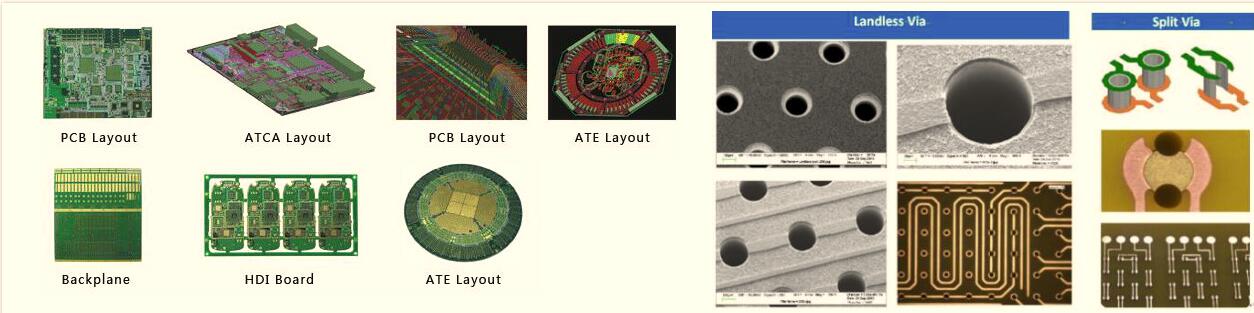
Wintech has been in the PCB design business since 1995. We specialize in high-speed PCB design, SI/PI/EMC analysis in addition to training and consulting. With our outstanding expertise at PCB design, we offer high-quality service for over 5,000 clients all over the world. We are the leading PCB design center in China with over more than 200 professional engineers.
Accelerate your product release through our specialized PCB Design & Layout service, ensure seamless factory transitions with NPI Engineering, and eliminate costly manufacturing bottlenecks early by leveraging our dedicated Manufacturing DFM Design audits.
Costly Mistakes Engineers Make When Applying PCB Adhesives
From our failure analysis investigations on returned electronics, technicians repeatedly commit five critical adhesive errors:
- Deploying Corrosive Acetoxy-Cure Silicones: Using cheap construction or bathroom silicone on circuit boards is a fatal error. Acetoxy silicones release acetic acid vapors as they cure, which corrodes copper traces, tarnishes silver contacts, and dissolves fine bonding wires within days. Always verify that the material is certified non-corrosive electronic-grade neutral-cure (alkoxy or oxime) silicone.
- Relying on Commercial Super Glue (Cyanoacrylate) for Structural Staking: Cyanoacrylate cures hard and fast, which tempts hobbyists and technicians. However, cyanoacrylates are notoriously brittle, have terrible impact resistance, and degrade rapidly at temperatures above 80°C. Over time, vibrations shatter the bond. Furthermore, cyanoacrylate emits volatile monomers that cause blooming or frosting—leaving an unsightly white chemical film across surrounding components.
- Using Standard Hot Melt Glue in High-Temperature Enclosures: Standard hobbyist hot melt glue (EVA-based) softens at temperatures as low as 60°C. Inside an enclosed power supply or industrial chassis where ambient temperatures easily exceed 55°C, hot glue softens, sags, and releases heavy components, allowing them to vibrate loose and short out against adjacent traces. If hot melt is required for rapid assembly, specify polyamide-based high-temperature electronic formulations.
- Failing to Account for Adhesive Outgassing: Standard industrial glues release plasticizers and solvents as they cure. In sealed enclosures housing optical lenses, laser diodes, or mechanical relay contacts, these outgassed vapors condense on optical glass or create insulating carbon films across relay contact points. Ensure adhesives comply with ASTM E595 outgassing standards.
- Skipping Cleanliness Checks Prior to Dispensing: Adhesives cannot form a stable bond over flux residues, fingerprint oils, or mold-release agents. Dispensing high-end epoxy over uncleaned no-clean flux results in interfacial peeling under minor mechanical loads. Boards must be thoroughly cleaned with deionized water or pure isopropyl alcohol before adhesive dispensing.
Critical Buying and Sourcing Considerations for Production
Before issuing purchase orders for electronic adhesives, purchasing teams and manufacturing engineers must audit these four technical parameters:
- Ionic Purity and Halogen Restrictions: Confirm that the adhesive manufacturer provides documentation certifying low halogen content and minimal extractable ionic contaminants (Cl-, Na+, K+ under 10 ppm). This prevents micro-electrochemical corrosion from forming beneath high-density packages over years of humid field deployment.
- Glass Transition Temperature (Tg) and Elastic Modulus: Review the technical data sheet for the polymer's Tg. Below its Tg, an adhesive is stiff and glassy; above its Tg, it becomes rubbery and expands rapidly. If your board operates near the adhesive's Tg, shifts in thermal expansion will exert mechanical stress on nearby components.
- Shelf-Life, Storage, and Dispensing Viscosity: Many high-performance single-part epoxies and SMT red glues require cold storage at -40°C or -20°C and have strict thawing windows before dispensing. Ensure your production facility has the cold-chain storage and automated syringe dispensing equipment necessary to handle the material's thixotropic index.
- Flammability and UL 94 V-0 Ratings: Commercial and consumer appliances mandate strict fire safety compliance. Ensure your staking glues and potting compounds carry certified UL 94 V-0 flame-retardant ratings, proving that the adhesive self-extinguishes within ten seconds of flame exposure without dripping burning polymers. When scaling production, coordinate with our comprehensive Supply Chain procurement Service to secure certified, fully traceable material lots.
Expert Recommendation and Assembly Sourcing Verdict
In most professional situations, treating adhesives as an afterthought is the fastest way to compromise an otherwise well-designed electronic assembly. We recommend establishing a strict chemical standardization protocol across your engineering and manufacturing lines: ban consumer hardware-store cyanoacrylates and acetoxy silicones from the facility entirely.
For structural anchoring of tall capacitors, inductors, and chassis brackets, standardize on non-corrosive neutral-cure electronic silicone to absorb harmonic vibration and thermal shock. For pad repair, permanent substrate staking, and terminal bonding, deploy high-Tg two-part structural epoxy. For rework stations, wire tacking, and fast prototyping adjustments, mandate UV-curable acrylics to eliminate production delays.
Most importantly, address component staking and thermal bonding during the PCB design phase rather than scrambling on the assembly floor. Partnering with an experienced, end-to-end design and manufacturing powerhouse like Wintech ensures that your board layouts incorporate proper mechanical clearances, optimal component spacing, and verified DFM guidelines, eliminating field failures before your products ever leave the factory. For comprehensive system integrations, explore our capabilities in Turnkey Box Build, support your engineering team with Engineering Design and Mechanical Design, evaluate critical reliability via Failure Analysis And Reliability, and validate your production lines through Testing Development And Service.
Frequently Asked Questions (FAQ)
Can I use regular super glue (cyanoacrylate) on a printed circuit board?
While regular super glue can be used for temporary, non-critical tacking, it is not recommended for professional or permanent electronics assembly. Cyanoacrylate is extremely brittle, has poor resistance to mechanical vibration, degrades rapidly at temperatures above 80°C, and outgasses vapors that leave a white, frosty residue across surrounding components and circuit traces.
What is the difference between acetoxy-cure and neutral-cure silicone for PCBs?
Acetoxy-cure silicone releases acetic acid (which smells like vinegar) during the curing process. This acetic acid is highly corrosive to copper, tin, silver, and solder joints, causing circuit failures. Neutral-cure silicone releases non-corrosive alcohol (alkoxy) or oxime byproducts as it vulcanizes, making it completely safe for direct contact with sensitive electronic components and printed circuit boards.
What is SMT red glue and why is it used during circuit board assembly?
SMT red glue is a single-part, heat-curing epoxy adhesive used in double-sided surface mount technology (SMT) manufacturing. It is applied between component pads to temporarily glue surface-mount passives to the bottom side of a circuit board. Once cured in a heat oven, it holds the components securely in place so they do not fall off when the board passes through a wave soldering bath.
Can hot melt glue be used safely on electronics?
Standard craft or commercial EVA-based hot glue should only be used for temporary, low-stress holding in low-temperature consumer devices. It softens at temperatures around 60°C, meaning the heat generated inside power supplies or enclosed electronics will cause the glue to melt, release components, and lose adhesion. For high-heat electronic environments, high-temperature polyamide hot melts or neutral-cure silicones must be used.
What adhesive is best for securing tall capacitors to prevent vibration damage?
Electronic-grade neutral-cure RTV silicone is the best adhesive for securing tall electrolytic capacitors. Its rubbery elasticity and high elongation allow it to absorb mechanical shock and harmonic vibration without cracking or transmitting destructive stress into the capacitor's leads and solder joints.
Authoritative References
- IPC International: IPC-A-610 Acceptability of Electronic Assemblies & Component Staking Criteria
- ASTM International: ASTM E595 Standard Test Method for Total Mass Loss and Collected Volatile Condensable Materials from Outgassing
- UL Solutions: UL 94 Standard for Tests for Flammability of Plastic Materials for Parts in Devices and Appliances


