

5 Exact Steps to Use ChatGPT Do PCB Design
The Intersection of Artificial Intelligence and Hardware
In the rapidly evolving landscape of electronic engineering, the integration of artificial intelligence into traditional workflows is no longer a futuristic concept. Engineers worldwide are constantly seeking innovative methods to accelerate their development cycles. As a full turnkey service and high-mix, low to mid volume electronics manufacturing provider, Wintech observes these industry shifts daily. Recently, a dominant trend has emerged: hardware developers attempting to use ChatGPT do PCB design to streamline their architecture phases.
Table of Contents
- The Intersection of Artificial Intelligence and Hardware
- The Reality Check: Can AI Truly Route a Board?
- Step 1: Concept Generation and Component Selection
- Step 2: Mathematical Calculations and Impedance Control
- Step 3: Scripting Automations for EDA Tools
- Step 4: Assisting with Design Rule Checks (DRC)
- Step 5: Bridging the Gap to Physical Manufacturing
- Summary Table: ChatGPT Integration vs. Wintech Capabilities
- Frequently Asked Questions
- Industry References
While an AI language model cannot physically open Altium or KiCad and draw copper traces visually, it possesses immense analytical capabilities. From our experience, if you understand the correct prompts and constraints, you can successfully use ChatGPT do PCB design tasks that traditionally consume hours of manual data sheet cross-referencing and mathematical calculation. In this authoritative guide, we will outline the precise methodologies hardware professionals utilize to implement AI into their board creation process, while highlighting the critical transition from digital conceptualization to physical realization.
The Reality Check: Can AI Truly Route a Board?
Before diving into the methodology, we must establish professional boundaries. If your goal is to type a prompt and receive a fully routed, multi-layer Gerber file, you will be severely disappointed. Large Language Models process text, not graphical spatial routing. Therefore, to use ChatGPT do PCB design effectively, you must treat the AI as a highly intelligent junior assistant or a sophisticated calculator, rather than a senior layout engineer.
At Wintech, we have partnered with many of the world's top 500 enterprises for years. We handle high level, high difficult, large size, and complex structure boards. We recognize that the true value of AI lies in the pre-layout phases: schematic ideation, component selection, script generation for EDA tools, and troubleshooting. When engineers decide to use ChatGPT do PCB design, they are fundamentally optimizing their data management before handing the complex spatial geometry over to our professional PCB Design & Layout teams.
Step 1: Concept Generation and Component Selection
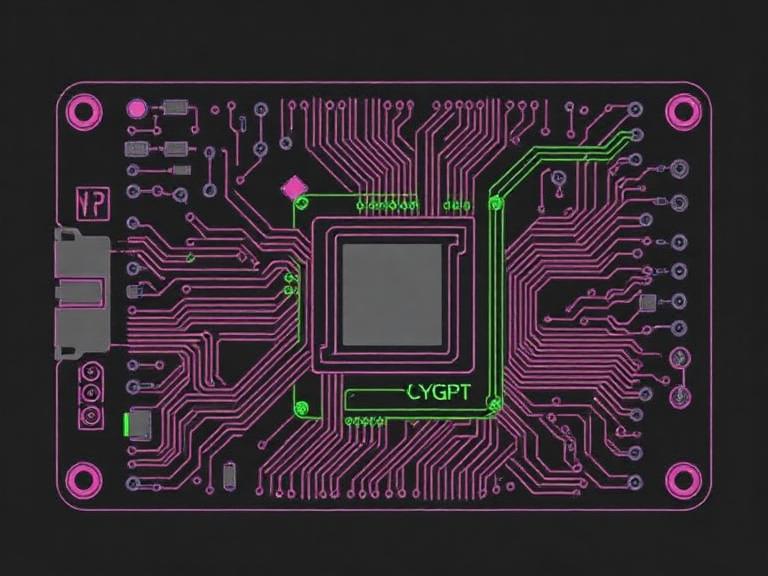
The first practical step to use ChatGPT do PCB design involves the creation of a functional block diagram and the initial Bill of Materials (BOM). Selecting the right microcontrollers, power management ICs, and passive components requires sifting through hundreds of PDF datasheets.
We recommend using highly specific prompts. Instead of asking "design a motor controller," you should prompt the AI with precise electrical constraints. For example: "I am designing a 24V BLDC motor controller. Suggest three highly available gate driver ICs that support 3.3V logic inputs, have integrated dead-time control, and are suitable for a high-vibration environment."
When you use ChatGPT do PCB design in this manner, it can rapidly compare specifications across manufacturers. Furthermore, you can ask the AI to generate a structured CSV table of your selected components, including standard package footprints (like 0603, QFN-32), which prepares your data for seamless integration into your EDA software's library manager.
Step 2: Mathematical Calculations and Impedance Control
High-speed digital designs and RF circuits require rigorous mathematical precision. Errors in trace width calculations lead to impedance mismatches, signal reflections, and ultimately, board failure. A highly effective way to use ChatGPT do PCB design is to deploy it as an advanced engineering calculator.
You can input your specific stack-up parameters into the chat interface. For instance: "Calculate the required trace width for a 50-ohm single-ended microstrip line. The dielectric constant (Er) of my FR4 is 4.3, the dielectric thickness is 0.1mm, and the copper weight is 1 oz." The AI will provide the mathematical breakdown using standard industry formulas (such as the IPC-2141 equations).
Step 3: Scripting Automations for EDA Tools
The most powerful method to use ChatGPT do PCB design lies in its ability to write code. Modern EDA tools like KiCad and Altium Designer support Python scripting to automate tedious layout tasks. If you lack programming experience, ChatGPT can bridge this gap entirely.
Suppose you have a circular board and need to place 60 LEDs evenly around the perimeter. Doing this manually is an exercise in frustration. Instead, you can use ChatGPT do PCB design automation by prompting: "Write a Python script for KiCad's pcbnew API that takes an array of components labeled D1 through D60 and arranges them in a perfect circle with a radius of 40mm, centered at coordinates (100, 100), rotating each footprint to face outward."
The AI will generate the Python script, which you can simply run within your EDA software's scripting console. This approach to use ChatGPT do PCB design saves countless hours of manual manipulation, allowing the engineer to focus on complex routing logic rather than geometric placement.
Step 4: Assisting with Design Rule Checks (DRC)
After you have routed the board, you will inevitably face a list of Design Rule Check (DRC) errors. Interpreting these errors can sometimes be cryptic. Another excellent strategy to use ChatGPT do PCB design is to feed these error logs into the model for clarification.
If your software throws an obscure warning about "Acid Traps" or "Antenna Violations," you can paste the exact error text into ChatGPT. It will explain the physics behind the violation and suggest practical layout adjustments to resolve it. However, it is vital to remember that fixing these errors requires human intervention in the layout software.
Step 5: Bridging the Gap to Physical Manufacturing
The final step in any hardware development cycle is moving from the digital realm to physical reality. You can use ChatGPT do PCB design ideation and automation, but an AI cannot manufacture a board. This is where Wintech's state-of-the-art solutions become indispensable.
We provide full systems electronic contract manufacturing solutions. Once your AI-assisted design is finalized, our New Product Introduction NPI teams take over. For hardware startups and global enterprises alike, speed is critical. We recommend leveraging our Quick Turn Fast PCB Prototype Assembly services to validate your AI-generated architectures rapidly.
Because we offer tailor-made solutions, our capabilities extend far beyond the bare board. If your product requires custom enclosures, our Plastic Molding and Metal Precision Machining divisions ensure that your physical product perfectly matches the mechanical constraints of your PCB. Wintech is worth relying on because we integrate the entire production chain under one roof—from initial PCB Assembly & PCBA SMT to final turnkey complete products.
Summary Table: ChatGPT Integration vs. Wintech Capabilities
| Development Phase | How to use ChatGPT do PCB design | Wintech Professional Services |
|---|---|---|
| Architecture & Ideation | Component selection, data sheet summarization, block diagram logic. | High precision PCB Layout engineering review and optimization. |
| Pre-Layout Calculations | Impedance formulas, thermal dissipation estimates, power budget calculations. | Material stack-up recommendations, New Product Introduction NPI. |
| Layout Automation | Writing Python scripts for KiCad/Altium component placement and teardrops. | Complex structure routing, HDI, blind/buried via implementation. |
| Physical Fabrication | Incapable. AI cannot manufacture physical goods. | PCB Manufacturing, Quick Turn Fast PCB Prototype Assembly. |
| Final Integration | Generating test procedures and documentation templates. | Plastic Molding, Metal Precision Machining, turnkey complete products. |
Frequently Asked Questions
Industry References
- IPC Standards for Printed Board Design and Manufacture
- Institute of Electrical and Electronics Engineers (IEEE): AI in Electronic Design Automation
- Wintech Internal Engineering Guidelines for High-Mix, Low to Mid Volume Electronics Manufacturing.
Embracing new technologies is essential for maintaining a competitive edge. By learning how to properly use ChatGPT do PCB design tasks, engineers can drastically reduce their administrative burden. When you are ready to bring those digital designs into the physical world, Wintech stands ready to provide unmatched prototyping, mass production, and full turnkey solutions.


