

Standard PCB Thickness Chart in mm and Inches
In the complex and demanding world of electronics manufacturing, precision is the ultimate goal. When designing a printed circuit board, engineers must meticulously evaluate a multitude of dimensional parameters. Among these, the physical thickness of the board plays a monumental role in defining the mechanical strength, signal integrity, and overall durability of the final electronic device. To ensure design viability and manufacturing success, referring to a reliable Standard PCB thickness chart is an indispensable step in the engineering workflow.
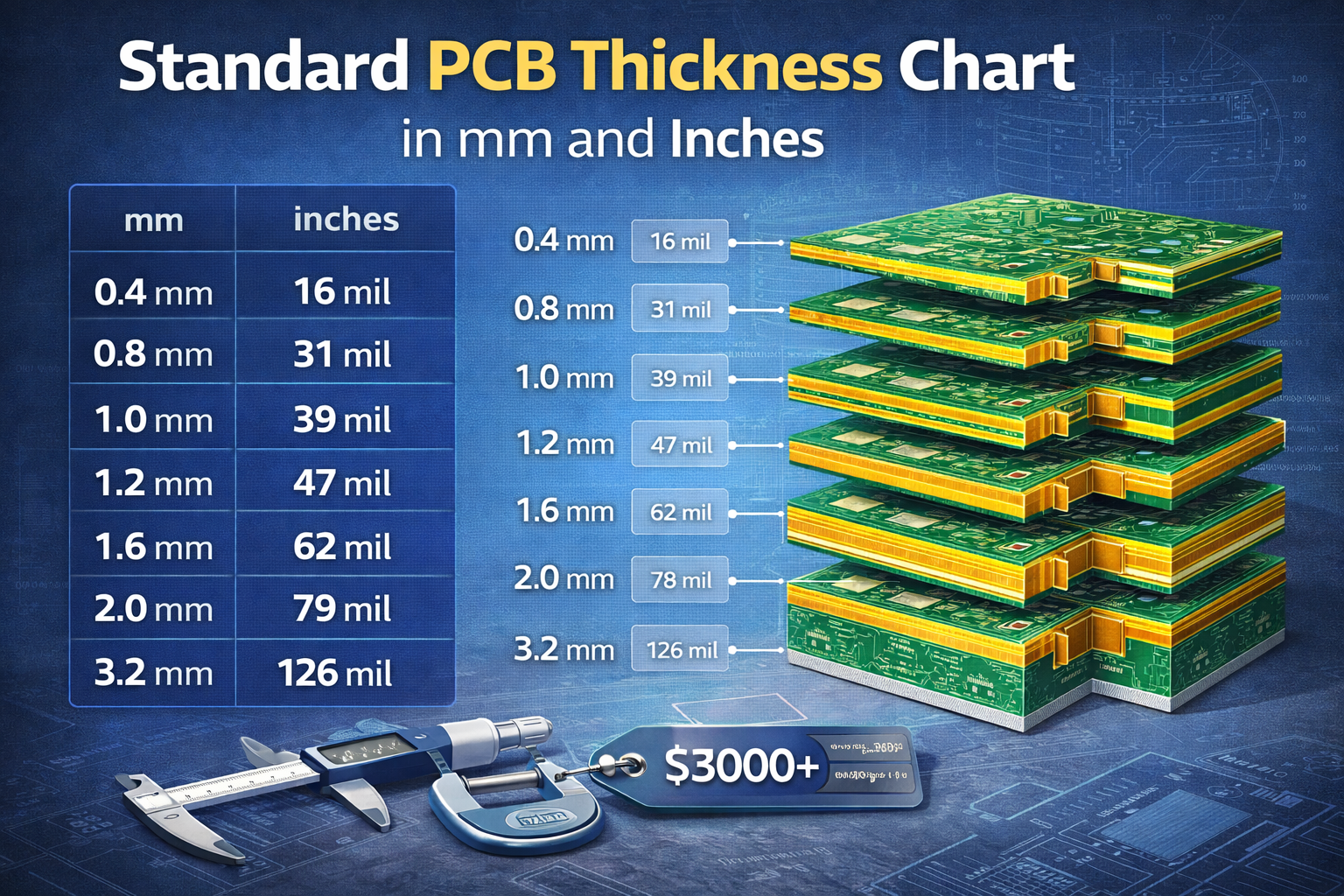
From our experience consulting with hardware developers globally, selecting the incorrect substrate thickness can lead to catastrophic assembly failures, impedance mismatches, and structural weaknesses under mechanical stress. Whether you are developing an ultra-compact wearable device that requires a flexible, paper-thin profile, or engineering a heavy-duty industrial power supply that demands extreme thermal mass, understanding the dimensions outlined in a Standard PCB thickness chart is foundational.
In this authoritative guide, we will explore the historical origins of printed circuit board dimensions, detail the exact measurements utilized in modern fabrication, and provide actionable insights into copper weights, layer counts, and dielectric properties. By the end of this article, you will possess the expert knowledge necessary to optimize your next hardware layout.
Table of Contents
- 1. The Origin of the 1.6 mm Universal Standard
- 2. The Primary Standard PCB Thickness Chart
- 3. Understanding Copper Weight and Thickness
- 4. How Layer Count Influences Overall Board Thickness
- 5. Key Engineering Factors When Choosing PCB Thickness
- 6. Full Turnkey Manufacturing Solutions with Wintech
- 7. Summary Table: Quick Reference Guide
- 8. Frequently Asked Questions (FAQs)
- 9. Industry References
1. The Origin of the 1.6 mm Universal Standard
If you have ever requested a default quote from a fabrication house, you likely noticed that the baseline thickness is almost always 1.57 mm or 1.6 mm. This specific measurement is equivalent to 0.062 inches or 0.063 inches. But why did the electronics industry settle on this highly specific fraction of an inch?
The answer lies in the early days of electronics manufacturing. Before the advent of fiberglass-reinforced epoxy laminates like FR4, early circuit boards were manufactured using Bakelite sheets and plywood. At the time, the manufacturing standard for these wooden sheets was exactly 1/16 of an inch, which translates to 0.0625 inches or approximately 1.57 mm. As technology evolved and the industry transitioned to advanced dielectric materials, the legacy tooling, edge connectors, and mounting hardware were already standardized around this 1/16 inch dimension. Consequently, 1.6 mm remains the default specification in any comprehensive Standard PCB thickness chart today.
2. The Primary Standard PCB Thickness Chart
While 1.6 mm is the historical default, modern electronics demand a vast spectrum of physical profiles. Below, we have meticulously detailed the Standard PCB thickness chart in mm and inches, along with the typical industry applications for each specific dimension.
| Thickness (mm) | Thickness (Inches) | Thickness (Mils) | Primary Category | Typical Engineering Applications |
|---|---|---|---|---|
| 0.2 mm - 0.4 mm | 0.008 in - 0.016 in | 8 - 16 mils | Ultra-Thin / Flex | Wearable technology, medical implants, high-density compact mobile devices, flex-rigid interfaces. |
| 0.6 mm - 0.8 mm | 0.024 in - 0.031 in | 24 - 31 mils | Thin / Lightweight | Smartphones, tablets, advanced IoT sensors, smart cards, and lightweight consumer electronics. |
| 1.0 mm - 1.2 mm | 0.039 in - 0.047 in | 39 - 47 mils | Mid-Range | Industrial controls, communication peripherals, USB modules, and moderate-stress consumer goods. |
| 1.57 mm - 1.6 mm | 0.062 in - 0.063 in | 62 - 63 mils | Industry Standard | Standard motherboards, general-purpose electronics, automotive controllers, Arduino/Raspberry Pi shields. |
| 2.0 mm - 2.4 mm | 0.079 in - 0.094 in | 79 - 94 mils | Thick / Rugged | Server backplanes, high-power LED arrays, heavy industrial machinery, complex multi-layer high-speed boards. |
| 3.0 mm - 3.2 mm | 0.118 in - 0.126 in | 118 - 126 mils | Heavy-Duty | Aerospace systems, military hardware, extreme high-current power supplies, ruggedized telecommunications. |
We recommend utilizing the chart above as a foundational guideline. However, you must remember that your final dimension will be affected by the lamination tolerances of the core, prepreg, copper foils, and outer finishes.
3. Understanding Copper Weight and Thickness
When engineers refer to a Standard PCB thickness chart, they often overlook the impact of the conductive copper layers. In the printed circuit board industry, copper thickness is uniquely measured by weight in ounces (oz). Specifically, it represents the weight of copper rolled out flat to cover exactly one square foot of area. The heavier the copper weight, the thicker the resulting metallic layer.
From our experience, standard logic boards utilize 1 oz copper (35 micrometers). However, power electronics requiring high current carrying capacity necessitate heavy copper builds, sometimes reaching 2 oz, 3 oz, or even 6 oz per layer. This added metallic mass directly increases the final z-axis profile of the board.
| Copper Weight (oz/ft²) | Thickness (µm) | Thickness (mm) | Thickness (Mils/Inches) | Standard Use Case |
|---|---|---|---|---|
| 0.5 oz | 17.5 µm | 0.0175 mm | 0.69 mils (0.0007 in) | Inner signal layers of high-density interconnect (HDI) boards. |
| 1.0 oz | 35 µm | 0.035 mm | 1.37 mils (0.0014 in) | Standard outer and inner layers for general electronics. |
| 2.0 oz | 70 µm | 0.070 mm | 2.76 mils (0.0028 in) | Power distribution networks, motor controllers, LED boards. |
| 3.0 oz | 105 µm | 0.105 mm | 4.13 mils (0.0041 in) | Heavy-duty power supplies and high-current industrial systems. |
4. How Layer Count Influences Overall Board Thickness
The total thickness of your printed circuit board is a cumulative calculation of core materials, prepreg (bonding material), and copper foil layers. Therefore, advancing from a simple 2-layer design to a complex 12-layer design dramatically alters your approach to navigating the Standard PCB thickness chart.
For a standard 2-layer or 4-layer design, hitting the universal 1.6 mm target is highly straightforward, utilizing a thick central FR4 core. However, as you escalate to 8-layer, 10-layer, or 12-layer architectures, achieving a 1.6 mm total profile requires the manufacturer to utilize ultra-thin cores and highly compressed prepreg sheets (such as 1080 or 106 styles). If your design incorporates thick 2 oz copper on multiple inner planes alongside an 8-layer count, restricting the board to 1.6 mm may become mathematically impossible or lead to severe dielectric breakdown risks. In such complex layouts, we recommend expanding your total specification to 2.0 mm or 2.4 mm to ensure structural and electrical integrity.
5. Key Engineering Factors When Choosing PCB Thickness
Selecting a measurement from the Standard PCB thickness chart is not merely about fitting the board inside a plastic enclosure. It impacts the very physics of how your circuit operates. We recommend closely evaluating the following four engineering constraints:
- Controlled Impedance: In high-frequency digital designs and RF circuits, the distance between the signal trace and the reference ground plane strictly dictates the characteristic impedance (e.g., 50 ohms for antennas, 90 ohms for USB, 100 ohms for differential pairs). Thinner dielectric layers increase capacitance, requiring thinner traces to maintain impedance. You must select a core/prepreg thickness that supports manufacturable trace widths.
- Mechanical Rigidity and Weight: If your board houses heavy components like large transformers, relays, or massive heat sinks, a 0.8 mm board will physically warp or bow under the weight, fracturing solder joints. You must select a 1.6 mm or 2.0 mm thickness to provide adequate mechanical rigidity.
- Edge Connectors and Hardware: If your board plugs into a PCIe slot or a specific edge connector receptacle, the thickness is strictly non-negotiable. PCIe standards demand a precise 1.57 mm insertion thickness. Using a 1.2 mm board will result in loose connections and data loss.
- Manufacturing Tolerances: Fabricating a circuit board is a chemical and mechanical process involving immense heat and pressure. The final thickness will always exhibit a tolerance, usually plus or minus 10%. A board specified at 1.6 mm may physically arrive measuring between 1.44 mm and 1.76 mm. Always account for this volumetric variance in your mechanical CAD enclosure designs.
6. Full Turnkey Manufacturing Solutions with Wintech

Transforming a complex digital schematic into a flawless physical board requires exact adherence to the specifications outlined in the Standard PCB thickness chart. From our experience, partnering with an elite manufacturer is just as critical as the electronic design itself. Wintech is a full turnkey service, high-mix, low to mid volume electronics manufacturing and custom material solutions provider with a proven track record of supplying state-of-the-art solutions to all global customer bases.
We provide tailor-made solutions for our customers, focusing specifically on high level, high difficult, large size, complex structure, and high precision requirements. Our comprehensive end-to-end capabilities begin with expert PCB Design & Layout to ensure your layer stack-up is viable for mass production. This is seamlessly followed by top-tier PCB Manufacturing utilizing the finest FR4, Rogers, and metal-core substrates available globally. Once the bare boards are fabricated, our advanced PCB Assembly & PCBA SMT lines populate your circuits with absolute robotic accuracy.
We highly recommend utilizing our Quick Turn Fast PCB Prototype Assembly service to validate your initial thickness constraints and impedance calculations. As your product matures, our dedicated New Product Introduction NPI team will flawlessly guide your project from prototyping, through low to mid volume batches, directly into full-scale mass production. Beyond bare electronics, our turnkey complete products full systems electronic contract manufacturing solutions encompass custom Plastic Molding and Metal Precision Machining. This allows us to assemble your PCBs directly into custom enclosures, delivering a shelf-ready product. Many of the world's top 500 enterprises have cooperated with us for many years. When precision and reliability are mandatory, Wintech is worth relying on.
7. Summary Table: Quick Reference Guide
To conclude our technical analysis, we offer this final summary table integrating layer counts with the data from the Standard PCB thickness chart, designed for quick referencing during your CAD layout phase.
| Layer Count | Optimal Thickness (mm) | Standard Copper Weight (Inner / Outer) | Typical Industry Sector |
|---|---|---|---|
| 1 to 2 Layers | 1.0 mm - 1.6 mm | N/A / 1.0 oz | Basic consumer goods, power adapters, LED modules. |
| 4 to 6 Layers | 1.6 mm | 1.0 oz / 1.0 oz | IoT devices, smart home appliances, standard medical equipment. |
| 8 to 12 Layers | 2.0 mm - 2.4 mm | 1.0 oz / 2.0 oz | Industrial automation, telecommunications, computing logic. |
| 14+ Layers | 2.4 mm - 3.2 mm | Variable (0.5 oz to 3.0 oz) | Aerospace, heavy military hardware, data center servers. |
8. Frequently Asked Questions (FAQs)
What is the most common dimension found on a Standard PCB thickness chart?
The absolute industry standard is 1.57 mm (0.062 inches), which is frequently rounded up to 1.6 mm in metric documentation. It provides the optimal balance of mechanical strength, dielectric spacing, and manufacturing cost for the vast majority of applications.
Does board thickness affect the cost of manufacturing?
Yes. Utilizing the standard 1.6 mm thickness is generally the most cost-effective option because manufacturers stock this FR4 material in massive quantities. Opting for ultra-thin (0.4 mm) or heavy-duty (3.2 mm) substrates requires specialized raw material procurement and adjusted press cycles, which increases the fabrication cost.
Can Wintech manufacture custom board thicknesses not listed on the standard chart?
Absolutely. While adhering to standard dimensions reduces costs, Wintech excels in tailor-made solutions. We can engineer highly specific custom stack-ups to meet strict impedance constraints or unique mechanical enclosure requirements using specialized core and prepreg combinations.
How does the solder mask and surface finish affect the final board thickness?
The dielectric substrate and copper layers comprise about 98% of the board's volume. However, the solder mask (typically 15 to 25 µm thick) and the surface finish (like ENIG or HASL) add a microscopic layer of thickness. When precision is critical, these finishing layers are calculated into the final ±10% manufacturing tolerance window.


