

Electronic Board vs Circuit Board: The Definitive 2026 Engineering Guide
In the vast and complex landscape of electronics manufacturing, terminology is frequently misused, leading to costly communication errors between design engineers, procurement managers, and manufacturing facilities. One of the most prevalent areas of confusion lies in the debate of electronic board vs circuit board. While these terms are often used interchangeably in casual conversation, in the realm of high-precision electronic contract manufacturing, they represent two distinctly different stages of a product's lifecycle.
Authored by Wintech — A full turnkey service, high-mix, low to mid volume electronics manufacturing and custom material solutions provider. With a proven track record of supplying state-of-the-art solutions to a global customer base, Wintech delivers tailor-made solutions: high level, high difficult, large size, complex structure, high precision PCB Layout, PCBAs and turnkey complete products full systems electronic contract manufacturing solutions. Many of the world's top 500 enterprises have cooperated with us for many years; Wintech is worth relying on. Learn more through the Wintech PCB company profile.
From our experience at Wintech, understanding the nuanced differences in the electronic board vs circuit board dynamic is critical for optimizing supply chains, managing costs, and accelerating time-to-market. A circuit board is the foundational blank canvas, whereas an electronic board is the completed, functional masterpiece. In this authoritative E-E-A-T compliant guide, we will dissect the mechanical, chemical, and operational differences between these two states of electronics, providing you with expert insights necessary for navigating your next mass production or prototyping run.
Table of Contents
- Summary Table: Electronic Board vs Circuit Board
- What is a Circuit Board (PCB)?
- What is an Electronic Board (PCBA)?
- Electronic Board vs Circuit Board: The Core Differences
- Diving Deep into Manufacturing Processes
- Navigating the Global PCB Manufacturing Landscape
- The Wintech Turnkey Approach
- Expert Recommendations for Procurement
- Frequently Asked Questions (FAQs)
- Industry References
Summary Table: Electronic Board vs Circuit Board
To establish a clear baseline in the electronic board vs circuit board comparison, we have developed the following summary matrix outlining the primary distinctions.
| Feature / Attribute | Circuit Board (PCB) | Electronic Board (PCBA) |
|---|---|---|
| Definition | Printed Circuit Board; the bare, unpopulated substrate. | Printed Circuit Board Assembly; the fully populated, functional unit. |
| Components | FR-4 (or other substrate), copper traces, solder mask, silkscreen. | PCB + Integrated Circuits (ICs), resistors, capacitors, connectors. |
| Functionality | None. Serves only as a mechanical base and electrical routing path. | Fully functional electronic system capable of processing inputs/outputs. |
| Manufacturing Process | Photolithography, etching, drilling, plating, surface finishing. | Solder paste printing, Pick-and-Place (SMT), reflow/wave soldering, AOI testing. |
| Testing Methods | Flying probe test, electrical continuity/isolation testing. | In-Circuit Testing (ICT), Automated Optical Inspection (AOI), X-ray, functional testing. |
What is a Circuit Board (PCB)?
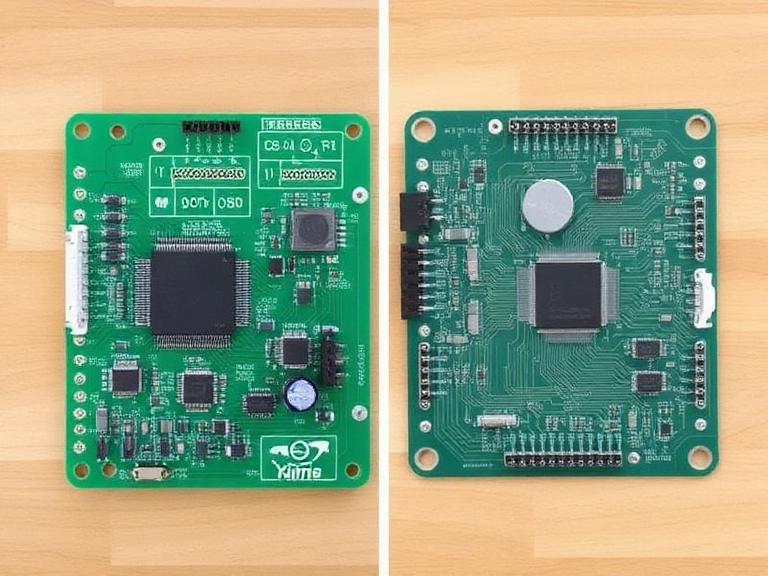
When engineers discuss a "circuit board," they are technically referring to a Printed Circuit Board (PCB). This is the bare, unpopulated board before any electronic components have been mounted. The primary function of a circuit board is twofold: to provide a rigid mechanical substrate to hold components, and to provide the conductive pathways (copper traces) that will eventually connect those components electrically.
A standard circuit board is a marvel of materials science. It typically consists of a core substrate—most commonly FR-4 (a woven glass-reinforced epoxy resin)—laminated with thin layers of copper foil. Through advanced fabrication processes, the unnecessary copper is etched away, leaving behind the intricate network of traces, pads, and vias. These bare boards are then coated in a solder mask (usually green, though available in many colors) to prevent short circuits during soldering, and finally, a silkscreen is applied to provide reference designators for assembly.
Sourcing high-quality bare boards is the first step in product realization. Procurement teams frequently reference the global PCB manufacturers list or look for low cost PCB manufacturers who do not compromise on base material integrity.
What is an Electronic Board (PCBA)?
Conversely, an "electronic board" typically refers to a Printed Circuit Board Assembly (PCBA). This is the state of the board after all active and passive electronic components—such as microprocessors, transistors, resistors, capacitors, and diodes—have been permanently soldered onto the bare circuit board. The transition from a circuit board to an electronic board is what gives the hardware its "brain" and functionality.
At Wintech, our full turnkey systems revolve around this transformation. The electronic board is the final module that goes into your smartphone, medical device, or automotive control unit. Because it contains expensive, sensitive components, an electronic board requires extreme care in handling, stringent static discharge (ESD) protection, and rigorous functional testing to ensure it meets the client's operational specifications.
Electronic Board vs Circuit Board: The Core Differences
To fully grasp the electronic board vs circuit board debate, we must analyze the differences across three core domains: the manufacturing processes, the operational functionality, and the lifecycle costs.
1. Manufacturing Process Differences
The creation of a bare circuit board is primarily a chemical and mechanical process. It involves photolithography (transferring circuit images), chemical etching (removing copper), mechanical drilling (creating vias), and electroplating. It is a messy, highly regulated process that requires immense wastewater treatment facilities.
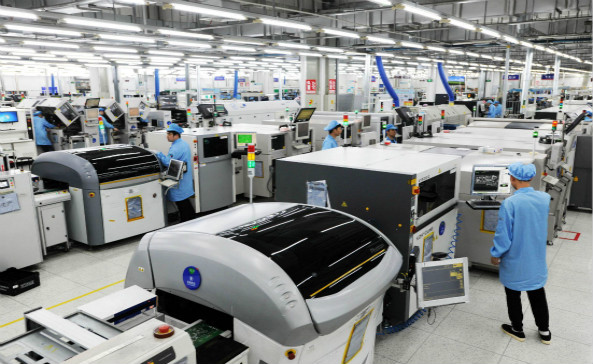
The creation of an electronic board (PCBA) is an assembly and metallurgical process. It involves stenciling solder paste onto the bare board, using robotic pick-and-place machines to mount microscopic Surface Mount Technology (SMT) components at high speeds, and passing the board through a reflow oven where the solder paste melts and solidifies to form secure electrical connections. This stage requires cleanroom-like environments and absolute precision.
2. Functionality and Application
A circuit board on its own does nothing. You cannot power it up, and it cannot process data. It is potential waiting to be realized. An electronic board is the realized potential. The distinction is critical when communicating with electronic PCB board manufacturers. If you request a quote for "1,000 circuit boards," you will receive pricing for bare fiberglass and copper. If you need fully functional products, you must specify "PCB Assembly" or "turnkey electronic boards."
3. Cost and Lifecycle
The cost disparity between a circuit board and an electronic board is massive. The bare PCB often accounts for only 10% to 20% of the total cost of the final electronic board. The bulk of the expense lies in the Bill of Materials (BOM)—the microchips, connectors, and sensors—as well as the highly specialized labor and machine time required for SMT placement and soldering.
Diving Deep into Manufacturing Processes
From our experience, the success of an electronic board is entirely dependent on the Design for Manufacturability (DFM) of the initial circuit board. If the pads on the bare PCB are incorrectly sized, the solder paste will not flow correctly during assembly, leading to tombstoning or solder bridges.
Wintech addresses this by providing full turnkey electronic contract manufacturing solutions. We manage the transition from blank circuit board to complex electronic board seamlessly. For clients exploring internal prototyping capabilities, checking out the best PCB printers 2025 can be helpful for early-stage proof-of-concept. However, for high difficult, large size, complex structure, and high precision PCB Layouts, relying on an established contract manufacturer is mandatory to scale from prototype to mass production.
Navigating the Global PCB Manufacturing Landscape
The supply chain for electronics is inherently global. Understanding where to source your boards impacts both cost and quality. When evaluating the electronic board vs circuit board supply chain, many companies look to Asia for fabrication and assembly.
- China's Manufacturing Hub: Facilities located in Shenzhen and surrounding areas remain dominant. Reviewing the top pcb board makers China provides insight into factories that can handle ultra-high volume bare board fabrication at aggressive price points.
- Southeast Asia: For companies seeking supply chain diversification to mitigate geopolitical risks, looking at PCB companies in Singapore and Malaysia offers high-tech, IP-secure alternatives for advanced PCBA.
- Global Powerhouses: The pcb manufacturing companies worldwide index is constantly shifting, but the trend is clear: full turnkey capability is the future. OEMs no longer want to buy bare boards from Supplier A and ship them to Supplier B for assembly.
The Wintech Turnkey Approach
As one of the best electronic manufacturing companies, Wintech eliminates the friction of managing multiple vendors. When you utilize our services, you don't have to worry about the electronic board vs circuit board disconnect. We handle the bare board fabrication, procure every single component on your BOM utilizing our vetted global supply chain, perform the SMT and Through-Hole Technology (THT) assembly, and execute full systems functional testing.
We excel in high-mix, low to mid volume electronics manufacturing. Whether your project requires standard FR-4, rigid-flex, aluminum-backed metal core boards (MCPCB), or High-Density Interconnect (HDI) structures, our state-of-the-art facilities are equipped to deliver. By reviewing the electronic manufacturing services companies landscape, you will see that our dedication to solving complex structure and high-precision challenges sets us apart.
Expert Recommendations for Procurement
We recommend that hardware engineers and procurement officers adopt the following strategies when bringing a new electronic product to market:
- Clarify Your RFQ: Never use the terms interchangeably in a Request for Quote (RFQ). Specify "Bare PCB Fabrication" if you only need the circuit board, and "Turnkey PCBA" if you require the finished electronic board.
- Engage Turnkey Partners Early: From our experience, engaging a turnkey manufacturer like Wintech during the design phase allows us to perform DFM and Design for Testing (DFT) checks. This prevents costly board respins later in the cycle.
- Consolidate the BOM: Let your assembly partner procure the parts. Contract manufacturers leverage massive economies of scale to source components cheaper and faster than individual engineering teams.
Frequently Asked Questions (FAQs)
Industry References
To ensure our clients have access to the highest standards of electronic manufacturing knowledge, the practices discussed in this guide align with the definitive standards set by global electronics associations. For further technical reading, we recommend consulting the following authorities:
- IPC - Association Connecting Electronics Industries (Standards for PCB Fabrication and Assembly)
-
Institute of Electrical and Electronics Engineers (IEEE) - Advancing Technology for Humanity


